
Have you ever wondered if your next exam could be the key to launching your military career? Our exam practice questions give you a real feel for what test day is like.
You'll work through challenges that mirror what you'll face in the field, from basic math puzzles to word challenges (simple tests of thinking skills). By practicing with realistic questions and clear answers, you build up your confidence and are ready to tackle the real deal.
This post is here to help you train your mind and build solid skills, step by step, so you can feel prepared and strong on exam day.
Practice Questions and Detailed Explanations for Military Career Exams

Working through practice questions that look like the real exam helps you feel more at ease and builds up your confidence. It gives you a clear picture of what test day will be like, so you can learn how to handle your time and spot your strengths, especially in areas such as Arithmetic Reasoning (math using numbers), Word Knowledge (understanding words), and Mechanical Comprehension (figuring out how things work). For example, a question like, “If 3 troops can set up a camp in 4 hours, how long will it take 6 troops?” helps you sharpen your quick thinking for when no calculator is allowed, just like warm-up drills prepare you for the field.
| Subtest | Question | Answer Options | Correct Answer & Explanation |
|---|---|---|---|
| Arithmetic Reasoning | If 3 troops can set up a camp in 4 hrs, how long for 6 troops? | [A] 2 hrs, [B] 4 hrs, [C] 6 hrs, [D] 8 hrs | A – Doubling the troops halves the time needed. |
| Word Knowledge | Select the synonym for “brisk.” | [A] Slow, [B] Quick, [C] Heavy, [D] Dull | B – “Quick” accurately reflects the meaning. |
| Mechanical Comprehension | Which simple machine is a lever? | [A] Inclined plane, [B] Wedge, [C] Screw, [D] See-saw | D – A see-saw serves as an example of a lever. |
Time pressure during the exam
No calculator rule for mental computation
Varied subtest topics demand diverse skills
Taking the time to go over detailed answer explanations does more than just show the right answer; it builds your overall test confidence. Watching each step of the reasoning process is like a clear drill plan, getting you ready for the fast-paced challenges of military career exams.
Structure and Timing of Military Career Exams
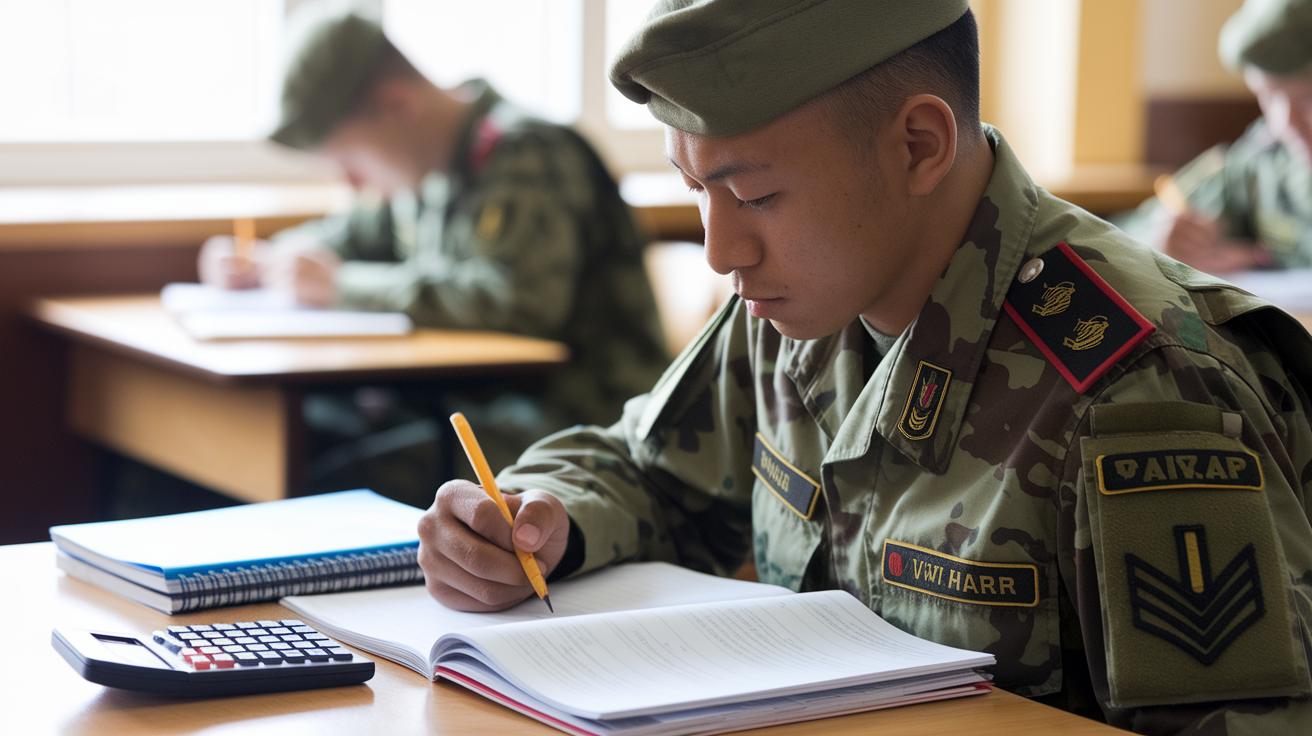
If you're heading into a military career, you'll face exams like the ASVAB. This test checks your skills, from problem-solving to logical thinking (a way to see how well you handle challenges), so you can find the best role for your talents. It's offered at over 14,000 schools and military stations, ensuring you get matched where you can truly excel.
The exam breaks into ten parts. It covers topics like Arithmetic Reasoning, Word Knowledge, Paragraph Comprehension, Mathematics Knowledge, General Science, Electronics Information, Auto & Shop Information, Mechanical Comprehension, and Assembling Objects. The time limits vary by version. For example, the computerized CAT-ASVAB gives you 135 questions to answer in 173 minutes. In contrast, the paper test has 225 questions to finish in 149 minutes. Each format is built to test different mental and hands-on skills while sticking to strict timing.
One neat aspect of the CAT-ASVAB is how it adapts to you. As you answer, the software tweaks the question difficulty so each one fits your level, kind of like a drill that scales up as you get better. The paper version, meanwhile, follows a fixed order, meaning every candidate gets the same set of questions for a fair and consistent test.
military career exam practice questions: Propel Your Success

When exam day comes, many candidates rush and end up misreading the multiple-choice answers on service tests. People often skim through the questions, and this quick pace leads to mistakes that take away valuable points. Test nerves and not being familiar with how the exam is set up can make this worse. For example, reading a question too quickly might cause you to pick an answer that seems right instead of choosing the one that fits perfectly.
Taking your time and using the process of elimination is a must for these exams. Try breaking each question into parts and crossing out answers that don't match. Since calculators aren’t allowed, it helps to sharpen your mental math with drills that mimic real test conditions. This steady, focused method lets you work through your allotted time without feeling overwhelmed.
Doing regular practice exams and reading the answer explanations can really boost your confidence. Spending at least two months preparing in a structured way gives you a chance to learn from every practice session. Just remember that you have to wait one month after your first or second try and six months before a third attempt, so use every practice run to build your skills and avoid extra retakes.
Practice Problems for Numerical and Verbal Reasoning on Military Career Exams

Your AFQT score is built on both verbal and numerical skills. These questions measure how well you understand words and tackle numbers fast, much like getting ready for an early-morning drill. Practicing these sections helps sharpen your language skills and basic math, just like rehearsing a mission until every move is second nature.
Take a look at this arithmetic challenge: If 4 soldiers finish a task in 8 minutes, how long would it take if 8 soldiers were working on it? Your choices are A: 4 minutes, B: 8 minutes, C: 10 minutes, and D: 12 minutes. The correct answer is A. Doubling the team cuts the time in half, much like having extra backup can lighten the load on a mission.
Next, here’s a word challenge. Pick the synonym for "swift" from these options: A: slow, B: rapid, C: heavy, or D: dull. The right pick is B since "rapid" perfectly matches the quick pace that "swift" implies.
Adaptive Versus Paper-Based Practice Drills for Military Career Exams

When you prepare for defense recruitment tests, it’s smart not to just count seconds or questions. Instead, focus on how each practice method sharpens your skills. Try practicing on both computerized CAT-ASVAB (a computer test that adapts based on how you perform) and paper tests. For instance, I once set a timer during a drill, pushed myself to answer quickly, and later circled back to the tougher questions.
Experiment by mixing up your strategies. With the CAT-ASVAB, work on speeding up your answers as the test adjusts to your performance. But when you’re working on a paper exam, practice keeping a steady pace through all the questions. This way, you build practical skills that will serve you well on exam day.
| Version Type | Question Count | Time Limit |
|---|---|---|
| CAT-ASVAB | 135 Questions | 173 Minutes |
| Paper Version | 225 Questions | 149 Minutes |
Focus your practice on the format that matches your thinking style and use these adaptive strategies to boost both speed and accuracy.
Branch-Specific Sample Questions for Military Career Exam Preparation

Practice questions are set up to match each branch's own scoring system. For example, the Army uses 10 line scores for military occupational specialty qualification (basically, they break down your skills into 10 parts). That’s why Army drills target specific skill areas. The Marine Corps builds in MOS codes (job role identifiers) to ensure the questions match the duties of each role. And the Air Force? They shape their exercises around key areas that are essential for service.
Custom drills help you zero in on what really boosts your chance of success. If you're aiming for an Army MOS, you might find more questions on mechanical comprehension. But if you're leaning toward an Air Force role, you could see more electronics-based scenarios. These tailored samples point you to the most important skills needed across the armed forces.
Planning Your Study Schedule for Military Career Exam Practice

Kick off your study plan with an 8-week timeline that lets you get comfortable with the exam layout and boost your skills. Think of these 8 weeks like a boot camp for your brain.
In the first week, sort out your study materials, set clear goals, and list which sections you need to master. This early stage builds a solid foundation before you dive into full-length practice tests.
Divide your schedule into weekly segments. One week, try a full exam under timed conditions to simulate the real experience. The next week, go over your answers, pay close attention to areas like arithmetic reasoning (simple math skills) and word knowledge (understanding words). This mix of complete drills and focused review is like switching between field exercises and a classroom briefing.
Finally, track your progress week by week. Notice which parts are still tough and adjust your study time accordingly. If you keep making mistakes in certain areas, plan extra review sessions and practice drills to tackle those issues. Keeping an eye on your progress will help you fine-tune your plan and grow more confident before exam day.
Final Words
in the action, we covered every core area, from detailed practice questions and timed subtests to study scheduling and branch-specific drills. The article walked through realistic examples, clear explanations, and careful comparison of exam formats, all meant to boost both physical and mental readiness.
Each section helps build the skills and confidence needed for success. Keep practicing your military career exam practice questions and stay focused, you've got this!
FAQ
Military career exam practice questions pdf
The military career exam practice questions pdf offers downloadable sample questions that mirror real test content and format, helping you study effectively with clear examples.
Military career exam practice questions and answers
The military career exam practice questions and answers pair sample questions with clear explanations, allowing you to review the rationale behind each answer and boost your confidence.
ASVAB practice test
The ASVAB practice test simulates the actual exam by presenting full-format questions and timing, so you can feel prepared and understand the test structure better.
ASVAB practice Test PDF
The ASVAB practice Test PDF provides a printable version of exam questions and answers, making it easy to study offline and review explanations at your own pace.
ASVAB practice test Air Force
The ASVAB practice test Air Force version focuses on areas crucial for Air Force candidates, offering targeted questions and clear explanations that align with branch-specific qualifications.
Free ASVAB practice test
The free ASVAB practice test gives you no-cost online access to a complete test simulation, helping you assess your skills and identify areas for improvement without financial commitment.
ASVAB test questions
The ASVAB test questions cover topics such as arithmetic reasoning, word knowledge, and mechanical comprehension, designed to evaluate your mental math and verbal aptitude skills.
ASVAB practice test PDF With answers
The ASVAB practice test PDF with answers delivers a comprehensive study tool, featuring both questions and detailed explanations that help clarify correct responses and deepen your understanding.
Is a 70 on the ASVAB bad?
A 70 on the ASVAB is not necessarily bad; it often meets the minimum requirements for many branches, though higher scores might be needed for certain specialized roles.
What kind of questions are on the military test?
The military test includes items on arithmetic reasoning, word knowledge, and mechanical comprehension, among other topics, to evaluate both your numerical and verbal skills.
How rare is a 99 on the ASVAB?
A 99 on the ASVAB is very rare, indicating an exceptionally high performance that puts you well above average and qualifies you for some of the most competitive military roles.
Is 21 a bad ASVAB score?
A 21 on the ASVAB is considered low compared to typical qualifying scores, suggesting that more preparation may be needed to meet the standards for many military occupational specialties.