
Ever wonder if you’ve got what it takes to nail the Navy ASVAB? This guide is like a friendly briefing before test day. It walks you through each part of the exam with clear, simple steps.
We break down tough topics like arithmetic into easy, manageable pieces. It’s like having a fellow service member standing by your side, ready to help you boost your score with straightforward advice.
With practical lessons and step-by-step tips, you’ll feel confident and ready. It’s direct, to the point, and designed to get you closer to a strong Navy career.
Navy ASVAB Study Guide Overview: Key Scores, Roles, and Downloadable Guide
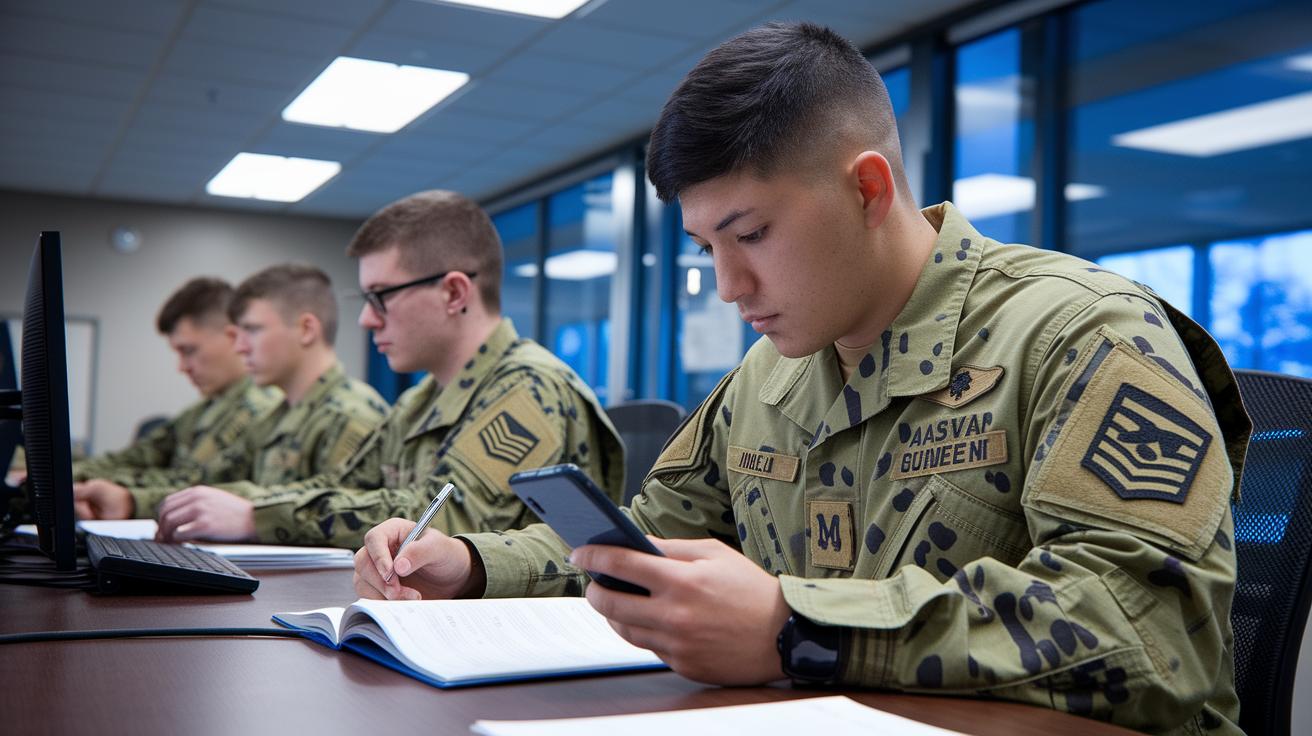
This ASVAB study guide helps you sharpen the skills needed for a range of Navy roles, from sailor to fighter pilot, corpsman, diver, or even Navy SEAL. It explains that Navy enlistment depends on your overall ASVAB (AFQT) score, not on separate section scores. Most folks score between 30 and 70, with around 50 as the average. Aiming for about 60 can open up even more opportunities.
The guide is free to download and breaks down all the core sections you need, with clear lessons in arithmetic, algebra, and more. It’s set up to boost your confidence and get you ready for test day. And if you want extra practice, check out the ASVAB Practice Test Navy, which offers drills specifically designed for maritime careers. Each part of the guide walks you through the steps in a friendly, easy-to-follow way, just like a briefing before a mission.
ASVAB Exam Format & Scoring for Navy Applicants

The ASVAB exam is split into nine different tests that cover a range of topics from math to technical skills. You’ll work through Arithmetic Reasoning (6 pages), Mathematics Knowledge (5 pages), Word Knowledge (1 page), and Paragraph Comprehension (2 pages). There are also tests on General Science (4 pages), Mechanical Comprehension (2 pages), Assembling Objects (1 page), Auto & Shop Information (5 pages), and Electronics Information (3 pages).
For your AFQT score (that’s the test that measures how well you handle numbers and words), the Navy combines your scores from Arithmetic Reasoning, Mathematics Knowledge, Word Knowledge, and Paragraph Comprehension. This score shows how you perform in both numeric and verbal areas. Each subtest has its own timing and number of questions, with the whole exam taking about 2½ hours.
This guide lays out the test content in a clear way and offers handy tips to help you plan your study sessions. Think of it like a friendly briefing before a mission, each section is a step that builds your confidence for a future Navy career.
Navy ASVAB Study Strategies for Key Test Sections

Get ready to tackle the ASVAB with a smart plan that hones in on math, verbal, and technical skills. These eight tips are like step-by-step drills that build your confidence.
• Start by reviewing core math areas like Arithmetic, Elementary Algebra, College Algebra, Pre-Calculus, Geometry, and Statistics. Practice problems every day to sharpen your number skills, kind of like running drills to stay mission-ready.
• Take full advantage of available lessons and grade reports to keep tabs on your progress. Regular test scores show you where you need extra practice, making your study time more efficient.
• Do timed drills and work on sample questions. This practice mirrors real test day conditions so you can learn to manage your time well when it counts.
• Improve your word skills with simple flashcards that cover key vocabulary. Spend a few minutes each day reviewing words and using them in sentences, just like memorizing important codes before a mission.
• Work on paragraph drills to pin down main ideas and make smart guesses about details. Think of it as figuring out a secret message during a quick briefing.
• For technical skills, get hands-on with tool identification exercises from the Auto & Shop Information section. Handling these tools in practice can turn abstract ideas into real, memorable lessons.
• Do schematic practice sessions for Electronics Information to get comfortable with circuit basics and Ohm’s law (a rule that explains how electricity moves through a circuit). It’s a clear way to build your technical foundation.
• Finally, boost your spatial awareness by practicing with 3D shape exercises for Assembling Objects and by reviewing science charts for General Science. These steps break down complex ideas into easy, real-life visuals that help you during the exam.
Navy ASVAB Practice Tests & Resource Hub

This section showcases interactive tools that go beyond your typical study methods. We focus on dynamic, time-based quizzes that mimic real test conditions while offering feedback right away.
Adaptive digital quizzes act like mission drills. They test your speed with a countdown clock. Imagine starting a timed quiz and racing through rapid-fire questions, just like a live exercise.
Interactive dashboards give you immediate insights into your performance. They break down your progress in ways that boring old PDFs simply can’t, letting you fine-tune your study approach as you go.
Gamified challenges add a fun, competitive twist to your ASVAB prep, turning studying into an exciting drill that keeps you on your toes, a real upgrade over traditional paper methods.
| Feature | Unique Benefit |
|---|---|
| Adaptive Quizzes | Instant feedback with a mission-style countdown |
| Interactive Dashboards | Real-time analysis of strengths and areas to improve |
| Gamified Challenges | Engaging drills that train quick responses |
All these features come together to form a complete, streamlined resource hub for Navy candidates who need more than the regular study aids.
Navy ASVAB Detailed Section Review: Arithmetic Reasoning & Mathematics Knowledge

Arithmetic Reasoning is all about working through word problems. In this part, you learn to turn everyday language into simple math equations. For instance, think of a problem that states, "A naval supply ship needs 15 barrels of fuel for every port it visits." You’d set up an equation like 15 multiplied by (number of ports) equals total barrels. This helps you spot the numbers and set up clear equations.
Mathematics Knowledge covers key math topics, including Algebra, Geometry, and Statistics. Here, you get to know the basic formulas and learn about shapes you might see in real-life problems. Imagine trying to solve for x in an equation or figuring out the area of a circle using its radius. You practice recalling and applying formulas during timed drills, just like running a quick mission.
Regular practice on both sections means working on tasks like setting up equations, remembering formulas, and completing drills quickly. These clear steps build the skills you need to nail the exam.
| Section | Page Count | Key Topics |
|---|---|---|
| Arithmetic Reasoning | 6 | Word problems, equations |
| Mathematics Knowledge | 5 | Algebra, Geometry, Statistics |
Navy ASVAB Technical & Science Section Breakdown

Assembling Objects takes up one page. Picture yourself fitting parts together like setting up a radar system on deck. Try to imagine constructing a ship’s control panel to sharpen your spatial skills.
Auto & Shop Information covers five pages. Focus on learning to recognize basic tools and simple vehicle maintenance skills. Think of it as a ship mechanic identifying essential tools during an inspection.
Electronics Information spans three pages. Here, you’ll study circuits and get a grasp on Ohm’s law (a basic rule that explains current flow). Picture a technician troubleshooting a ship’s radio by checking the wiring and applying simple circuit ideas.
General Science takes up four pages and looks at topics like physics, chemistry, biology, and earth science. Connect these ideas to real life, such as understanding forces on deck or the properties of seawater.
Mechanical Comprehension stretches over two pages and introduces concepts like levers, gears, and hydraulic principles. Imagine a ship's crane using levers and pulleys to hoist heavy loads, all about understanding how things move.
| Section | Page Count | Key Topics & Study Tips |
|---|---|---|
| Assembling Objects | 1 | Practice 3D visualization; tip: imagine building a ship’s control panel |
| Auto & Shop Information | 5 | Tool identification and basic maintenance; tip: picture a mechanic checking tools |
| Electronics Information | 3 | Circuits and Ohm’s law basics; tip: think like a technician fixing a ship’s radio |
| General Science | 4 | Physics, chemistry, biology, earth science; tip: connect science to ship operations |
| Mechanical Comprehension | 2 | Levers, gears, hydraulics; tip: imagine a ship’s crane lifting heavy loads |
Navy ASVAB Verbal Skills & Comprehension Review

Word Knowledge gets its own page. It dives into clues for vocabulary and drills on root words. You can use GRE-style flashcards to sharpen your language skills. Picture a flashcard showing a word like "mitigate" with a clear definition that simply means to lessen, kind of like easing tension on deck.
Paragraph Comprehension fills two pages. It helps you spot main ideas and read between the lines, like when you notice the safety message in a ship’s routine maintenance report. Timed reading drills act like a brisk mission briefing, teaching you to scan paragraphs quickly and clearly.
Practice exercises guide you to map out the structure of a paragraph. Think of it like a pre-mission checklist: pinpoint the main point, check the details, and then make smart inferences about what isn't directly said.
Stick with these strategies, and you'll build a strong verbal foundation. This boost in confidence helps you communicate clearly, especially when every word counts under exam conditions.
Navy ASVAB Sample Study Schedule & Progress Tracking

Set up a six-week study plan with 90-minute sessions every day to keep you on track. Start with Weeks 1 and 2 focused on brushing up on math basics. Imagine getting your equations sorted like you’d check your gear before a drill. Keep practicing simple arithmetic and basic algebra until those skills feel as reliable as a steady ship.
Next, in Weeks 3 and 4, shift your attention to technical and science work. Spend time on electronics basics, learning to identify tools, and covering science topics like simple physics or earth science. Think of it like checking every part of your ship to make sure it’s running right.
In Week 5, turn your focus to verbal skills. Work on vocabulary drills and paragraph exercises, just like you’d sharpen clear communication for a briefing. Then, use Week 6 to take full-length practice tests. These full runs mimic real exam conditions, helping you get your timing just right.
Member dashboards can be a huge help. They show your grades and progress in each section so you can see where you might need a little extra work.
- Weeks 1–2: Math fundamentals
- Weeks 3–4: Technical and Science drills
- Week 5: Verbal mastery
- Week 6: Full-length practice tests
Use these checkpoints to measure your strengths and adjust your study focus as you move ahead.
Navy ASVAB Scores & Career Path Insights

Your Navy ASVAB score is key to shaping your future at sea. When you score over 60, you unlock special career tracks, think corpsman, diver, or even getting a shot at SEAL training. It’s like earning a fast pass to some top-tier roles where every extra point can make a big difference. If you score between 50 and 59, you'll qualify for general enlisted jobs and have plenty of opportunities aboard. And if your score falls between 35 and 49, you'll meet the basic entry requirement, though you might need to boost your score later to qualify for specialized roles.
The Navy relies on your overall AFQT score (a quick test that checks how well you think) to place you into the right classes and specialized schools. That way, every recruit finds a role that matches their skills. When you get your results, take a moment to review them with a military entrance counselor. Focusing on the test areas that could use some improvement can really help set you up for a solid seafaring career.
For more info on how your scores line up with available career paths, check out the Military Entrance Exam Guide here: https://militaryaptitudetests.com?p=206
Final Words
in the action, the article broke down Navy ASVAB essentials, from score expectations and subtest details to focused study tactics for math, science, verbal, and tech skills. It offered a clear step-by-step schedule with progress tracking to help build your confidence and readiness. You'll also find valuable tips on matching your scores with Navy career options. Our asvab study guide navy resource is a smart tool to boost your test approach and solidify your path. Stay motivated and keep sharpening your skills, you’ve got what it takes for success.
FAQ
Where can I find a free downloadable Navy ASVAB study guide in PDF, printable, or online formats?
Free Navy ASVAB study guides are available as PDFs and printable versions designed for quick access, making it easier to review key concepts without cost.
How do you study for the ASVAB Navy?
Navy ASVAB study tips include a mix of math drills, verbal flashcards, technical reviews, and scheduled practice tests to build confidence and improve overall performance.
What does a good Navy ASVAB score look like and how difficult is the test?
Scores around 72 to 90 are strong, while the test challenges candidates with diverse subjects, so focused study in each section makes the exam more manageable.
How can I practice with Navy ASVAB practice tests?
There are interactive, timed ASVAB practice tests that simulate the exam format, offering candidates regular feedback and helping them sharpen skills before enlistment.