
Ever wonder how your ASVAB scores can shape your future in the Marines? Your ASVAB isn’t just numbers on paper; it shows your everyday skills and helps match you with the job that fits you best.
Each test section, from science checks to math challenges, is a chance to prove what you’re made of. Think of it as drawing up a clear plan for your success in the Corps. Ready to see how these skills can boost your confidence and steer you on the right path?
ASVAB Test for Marines: Overview and Purpose
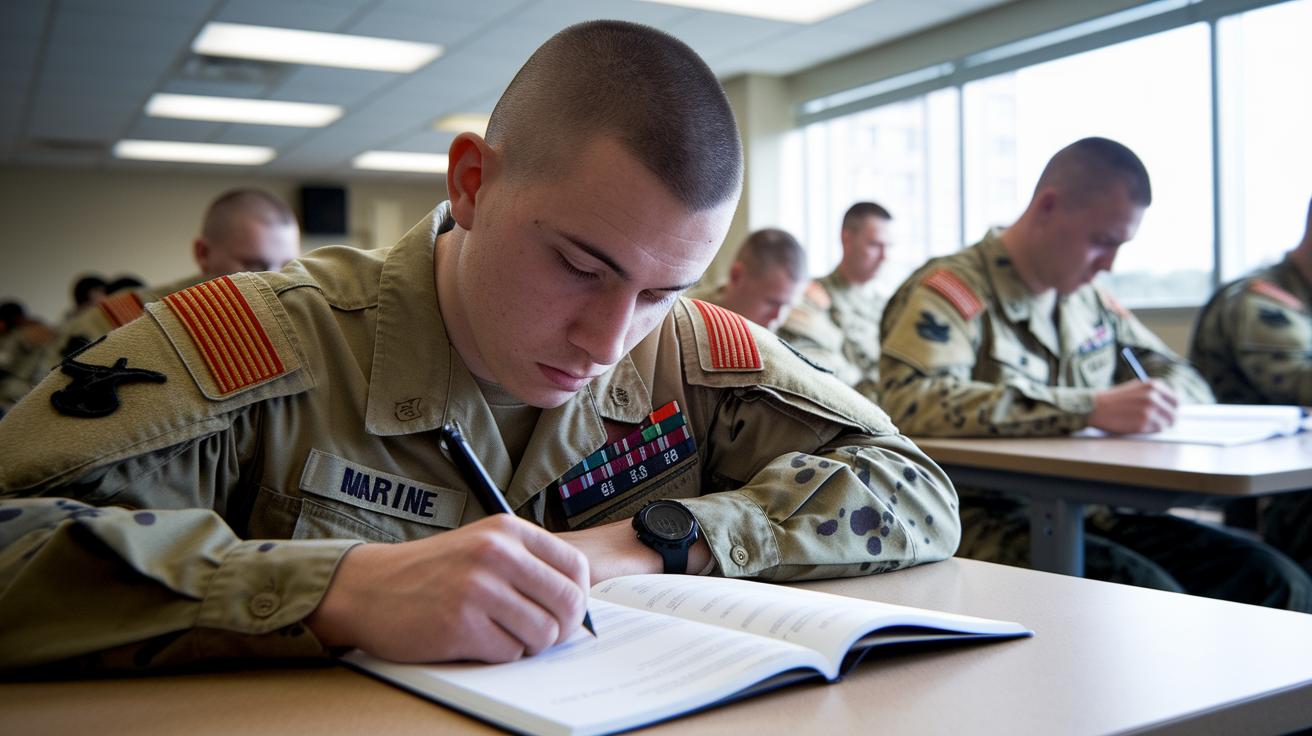
The ASVAB for Marines is an important test that shows how ready you are for different military tasks. It covers nine separate areas: General Science, Arithmetic Reasoning, Word Knowledge, Paragraph Comprehension, Mathematics Knowledge, Electronics Information, Auto & Shop Information, Mechanical Comprehension, and for MEPS candidates, Assembling Objects. Each section checks a specific skill you need for daily military work, helping to set you up with the right job in the Corps.
Marine recruiters use your scores to figure out which Military Occupational Specialty fits best. For example, the clerical score is calculated by adding your Word Knowledge, Paragraph Comprehension, Arithmetic Reasoning, and Mathematics Knowledge scores. On the other hand, the AFQT (Armed Forces Qualification Test) score combines your Verbal Expression (Word Knowledge plus Paragraph Comprehension), Arithmetic Reasoning, and Mathematics Knowledge scores. If you have a high school diploma, you need at least a score of 31. If you earned a GED, you need a 50, and many specialized roles prefer scores of 60 or above.
Right now, they’re making changes by removing tests like Numerical Operations and Coding Speed. Knowing what the test covers can help you focus your study time and boost your confidence. For more details on what the ASVAB includes, check out the link: what is the asvab.
Subtest Breakdown of the Marine ASVAB Test

The Marine ASVAB tests your skills in nine different areas. First, the General Science part checks what you know about biology, chemistry, and physics by breaking each topic down in simple terms, linking everyday science to practical military use. The Arithmetic Reasoning section puts your everyday math skills to the test, imagine having 16 questions in 39 minutes where you use common calculation tricks.
Next, the Word Knowledge and Paragraph Comprehension sections see how well you know words and understand written passages. These skills are key for clear, effective communication in the field. Mathematics Knowledge covers topics like algebra, geometry, and probability, usually with 15 questions in 24 minutes, so you have to keep an eye on the clock.
Then, the Electronics Information section checks your grasp of basic electrical ideas (think power systems and simple circuits). The Auto & Shop Information part tests your understanding of car repairs and even covers basics from woodworking or metalworking classes. Mechanical Comprehension looks at how well you understand machines and physical equipment. Lastly, if you’re a MEPS candidate, the Assembling Objects section measures your ability to study shapes and figure out how they fit together.
Each part comes with its own set of questions and tight time limits. Breaking the test down like this helps you pinpoint where you might need a bit more practice to boost your performance.
ASVAB Scoring Guide and Marine Corps Line Scores

Your AFQT score is like a quick check on your readiness. It adds up three main parts: Verbal Expression (from Word Knowledge and Paragraph Comprehension), Arithmetic Reasoning, and Mathematics Knowledge. If you have a high school diploma, you need at least 31. GED holders should aim for 50, but shooting for 60 or more is a smart move if you want technical Marine roles.
Marine recruiters also look at line scores, which mix results from different subtests. For instance, the Clerical score sums your Word Knowledge, Arithmetic Reasoning, and Mathematics Knowledge marks. Meanwhile, the Combat score groups together Arithmetic Reasoning, Mechanical Comprehension (a test of how well you understand physical tasks), Assembling Objects, and Verbal Expression. These groups of scores help match you to the right Military Occupational Specialty by checking you against specific job standards.
Keep in mind that changes are in the works. Tests like Numerical Operations and Coding Speed are being replaced, which could tweak how some of these scores are calculated in the future.
| Score Type | Components | Requirement/Target |
|---|---|---|
| AFQT | VE+AR+MK | Min 31 HS Diploma / 50 GED (Target 60+) |
| Clerical (CL) | VE+AR+MK | Varies by MOS |
| Combat (CO) | AR+MC+AS+VE | Job-specific benchmarks |
Knowing these score details can help you focus your study sessions and work on the right subtests for a solid Marine Corps career.
ASVAB Test for Marines: Your Boost to Success

Start your prep by taking a full-length practice test. This test shows you what you do well and where you might need extra work. Imagine breezing through Word Knowledge while stumbling a bit on Mathematics Knowledge. That gives you a clear roadmap for improvement.
Next, try practicing with a timer to sharpen your pacing. For instance, spend 39 minutes on 16 Arithmetic Reasoning questions. This drill helps you get used to quick thinking under pressure.
Another tip is to use educated guessing. If you’re stuck on an Electronics Information question, cross out the answers that just don’t make sense. This strategy can help you find the best choice.
Focus on one subtest at a time and review any mistakes right after. Ask yourself, “What concept did I miss?” Using active recall and spaced repetition for vocabulary and math formulas will make your study sessions even more effective.
- Take timed practice tests.
- Review your error patterns.
- Work on one subtest per session.
These tactics can boost your confidence while you zero in on the areas that need the most work during your Marine ASVAB preparation.
Exam Preparation Tips for the ASVAB Test for Marines

Plan a study schedule over eight weeks and set aside one to two hours a day for key subjects. Start by taking a quick diagnostic test to see where you need extra help. For instance, if Arithmetic Reasoning (math problems you solve with numbers) is tough, spend an extra session on it to boost your confidence. Use trusted ASVAB prep books and online courses as your guides. Sometimes, it’s like when you’re working through electrical concepts and, after a while, things just click, pretty satisfying, right?
Next, do a full-length practice test each week. This shows you how well you handle the exam’s pace and pressure. And hey, consider joining a study group or teaming up with a tutor to stay on track. Chatting with peers or a mentor can give you fresh ideas and strategies you might not have tried on your own.
Finally, adjust your study plan based on how you do on these practice tests. If one week your General Science score drops, add some extra study time for that topic. And remember, getting 7–8 hours of sleep each night, especially as test day nears, will help you stay sharp and ready.
Study Resources and Practice Materials for the Marine ASVAB Test

Get ready to dive into a variety of study tools that make your prep both engaging and effective. You can find free ASVAB PDF guides and Marine-specific question sets online, complete with sample questions like “If a vehicle moves 45 miles in one hour, what is its speed?” that help you practice for real-life scenarios.
Think about grabbing a commercial prep book. These books come with detailed diagnostic tests and step-by-step explanations for each question, kind of like a drill sergeant breaking down a tough new task. And don’t forget mobile apps with timed quizzes for each part of the test; they mimic actual test-day conditions and really help sharpen your pacing.
Also, consider attending boot camps or working with a Marine ASVAB tutoring service. These sessions give you personal feedback and focused review to pinpoint areas where you might need extra help. By mixing both free and paid resources, you build the confidence and skills you need to succeed.
Time Management and Test Day Tips for Marine ASVAB Success

Get to the test center with plenty of time to spare so you’re not rushing during check-in or nervously searching for your spot. Bring your valid ID and any needed paperwork to avoid any unwanted delays. If you hit a tough question, go with your gut on the first try and mark it for a quick review later. For example, if an arithmetic problem trips you up, flag it and move on, you can always circle back.
Use all the time you have since there’s no penalty for guessing. Even when the clock is ticking down, take a moment to check over your answers. During the exam, give yourself small breaks between sections by taking a few deep breaths; it helps clear your head and keeps you focused.
Before the test ends, ask the proctor about the final steps so you know exactly what to do. This little extra step can keep your mind clear and help keep your nerves in check.
Final Words
In the action, this article broke down the asvab test for marines from subtest details to score calculations and exam strategies. We shared clear study methods, practical time management tips, and useful resource recommendations. The advice is meant to build both your mental focus and physical readiness. Each section offers practical insights, so you can tackle the test with confidence. Stay determined and keep refining your preparation, the path to success is built step by step.
FAQ
What is an ASVAB practice test?
An ASVAB practice test simulates the real exam and helps you assess your strengths and weaknesses, guiding you to focus on areas that need improvement for a better test performance.
How do Marine ASVAB scores affect job opportunities?
Marine ASVAB scores guide job placement by matching line scores to specific roles. Higher scores broaden your job options, increasing your chances for technical and specialized Marine assignments.
How do ASVAB test questions and answers help with preparation?
Using ASVAB test questions and answers builds your confidence by reviewing key topics and problem-solving methods, allowing you to understand solutions and navigate the exam more effectively.
What benefits does an ASVAB practice test for Army offer?
An Army ASVAB practice test offers a realistic exam experience that helps you identify areas for improvement, build test-taking stamina, and manage time during the actual exam.
How can free ASVAB practice tests assist me?
Free ASVAB practice tests provide accessible practice opportunities online, letting you examine your skills, pinpoint weak spots, and hone techniques without incurring extra costs.
What advantages does an ASVAB Practice Test PDF provide?
An ASVAB Practice Test PDF delivers printable study materials that let you review content offline, making it easier to focus on exam topics without digital distractions.
How long is the ASVAB test?
The ASVAB test takes about three hours overall, with each subtest having a set time limit. This structure requires you to manage pacing and balance speed with accuracy.
What is the purpose of an ASVAB practice test for the Air Force?
An Air Force ASVAB practice test mirrors the exam’s structure and timing, helping candidates familiarize themselves with question formats and build the skills needed for success in Air Force roles.
What ASVAB score is needed for Marines?
The ASVAB score needed for Marines generally starts at a minimum AFQT of 31 for high-school diploma holders, with a target of around 60 or above for more technical Marine positions.
How hard is the ASVAB test for Marines?
The Marine ASVAB test covers a range of topics that can be demanding. Consistent practice and study make it manageable, enabling you to overcome challenges with effective preparation.
Is a 72 a good ASVAB score?
A score of 72 is considered strong and generally exceeds the minimum requirements, providing you with a solid edge for a wider variety of military occupational specialties.
What disqualifies you from the Marines?
Disqualifiers for the Marines include not meeting the minimum ASVAB scores, failing physical or medical standards, and having certain legal issues. Meeting all fitness, academic, and behavioral criteria is crucial.