
Ever thought a test could shape your future? Military aptitude tests do more than fill out a paper. They help you see what you’re good at and where you might need a little extra work.
Each year, millions of folks take the ASVAB (a test that shows your strengths) to find the best roles in the Army, Navy, and other branches. It’s like getting a snapshot of your skills before stepping onto the field.
In this article, we’ll walk you through how these tests can set you on a solid path toward a rewarding military career.
Overview of Military Aptitude Tests for Enlistment

Military tests like the ASVAB help check your strengths and see if you're a good fit for service. The Department of Defense made the ASVAB, which tests high school and college graduates to see if they'll do well in military training. Every year, over a million people take these tests so recruiters can place them in the right branch, like the Army, Navy, Air Force, Marines, or even the Space Force.
These exams give recruiters key data that helps match you with a job where you'll shine. Think about it, a young recruit nailed the test and showed strong analytical skills, making him a perfect fit for a technical role in the Air Force. This is a clear example of how test results can guide career placements and training decisions.
Your ASVAB scores are added up in the AFQT, a combined score from several subtests that decides if you're eligible for enlistment. Besides matching you with the right job, these tests also show where you might need a little extra work before starting your service.
The structured and easy-to-follow setup of the ASVAB makes it a vital tool in today's military recruitment. As you work through the exam, you learn more about your strengths and which career paths suit you best, setting the stage for a rewarding military career built around your skills.
In short, your test results give you the power to plan out your future.
Types of Military Aptitude Tests and Versions

There are three basic types of military aptitude tests. They vary in the way questions are given and the amount of time you have. The CAT-ASVAB is a computer-based test that adapts to your answers (each answer changes the next question’s challenge). You face 135 questions in 173 minutes. Many folks pick this test because it can be quicker overall.
The P&P-ASVAB is the old-school paper and pencil version. It has a fixed set of 225 questions that you must finish in 149 minutes. Unlike the adaptive test, every candidate gets the same questions in the same order.
Then there’s the PiCAT. This test is done online without a proctor and serves as a pre-screen. The number of questions and time limits can change with PiCAT, making it more flexible. Each version of the test is offered at Military Entrance Processing Stations (MEPS), Military Entrance Test sites (MET), or at one of over 14,000 schools and testing centers across the country. This means nearly every candidate can find a convenient spot. Many even use PiCAT as a first step before the official exam.
| Version | # Questions | Time Limit |
|---|---|---|
| CAT-ASVAB | 135 | 173 min |
| P&P-ASVAB | 225 | 149 min |
| PiCAT | Variable | Variable |
Structure and Content of Military Aptitude Tests: The ASVAB Exam

The ASVAB exam is broken into 10 mini-tests that check the different skills needed for military roles. Each mini-test covers areas like Arithmetic Reasoning, Word Knowledge, Mechanical Comprehension, and General Science. Think of it like working through quick mission calculations, it ties everyday problems to the test topics.
The computer version, called the CAT-ASVAB, adapts its questions based on how you’re doing. Get off to a good start, and it ups the challenge; take a bit more time, and you might see easier ones. On the flip side, the paper-and-pencil version (P&P-ASVAB) gives everyone the same fixed set of questions in the same order. And just a heads-up: you won’t be allowed any calculators, so you’ll have to do the math by hand.
Each mini-test includes anywhere from 11 to 35 questions, adding up to about 225 total items. This setup helps test your abilities from all sides. If you’re curious about more details, check out the full explanation at what is the asvab. Try practice techniques that drill down on the main ideas so you’re ready for any format on test day.
Scoring Mechanics for Military Aptitude Tests and Branch Requirements

Each part of the test is scored from 1 to 99, showing how you performed against a national sample. After you finish, your scores in subjects like Word Knowledge, Paragraph Comprehension, Arithmetic Reasoning, and Mathematics Knowledge are converted into percentiles. For instance, if you're in the 85th percentile, you've outscored 85 out of every 100 test-takers.
Your overall AFQT score (a composite score that helps decide if you’re eligible to enlist) is built from these key areas. There isn’t one universal pass or fail; every military branch sets its own minimum AFQT requirements. So, the score needed for the Air Force might be different from what another branch requires.
In addition to the AFQT, the ASVAB provides line scores (these are scores that match your skills to specific military jobs). These line scores qualify you for over 480 roles by linking your unique strengths to a job specialty. Think of it as being assigned a role on your team that fits your abilities perfectly.
Quick recap:
| Key Point | Description |
|---|---|
| Percentile Ranking | Shows how your performance compares to others |
| AFQT Composite | Determines basic enlistment eligibility |
| Line Scores | Matches your skills to military specialties |
This scoring setup helps recruiters spot your overall potential and find the right career fit in the military.
Key Preparation Strategies for Military Aptitude Tests

Start by really understanding the ideas behind each test topic. Instead of just memorizing answers, take practice tests that feel just like the real exam. This works like rehearsing a drill before heading out on a mission. When you run these tests, you'll notice common patterns in the questions, so you know what might be coming on test day. For example, imagine training by running through a practice obstacle course before the actual challenge, it boosts your skills and builds your confidence.
Next, explore the study resources available. You'll find subject-specific practice tests, detailed study guides, and even online prep courses (like the step by step military test preparation guide you can check out online). These tools help you spot areas where you might need a little extra work. It’s a bit like going through a sample drill: first review the key points, then take a full practice exam to feel the pace and pressure.
Before you schedule a retake, take some time to look back at your previous performance. Learning from past mistakes can turn a rough start into a steady march forward. Always keep in mind that truly understanding the material beats just memorizing answers.
Here are the steps to get ready:
- Take an initial diagnostic practice exam
- Identify areas where your performance was weak
- Plan focused study sessions
- Use practice tests for each subject
- Go over your mistakes and review the core ideas
- Simulate full-length, timed exams
- If needed, plan to retake the test after one month
Each of these steps builds your readiness, much like planning and practicing for an important mission. With clear planning, regular practice, and honest review, you'll be set to perform confidently even when the pressure is on.
Scheduling, Testing Locations, and Retake Policies for Military Aptitude Tests
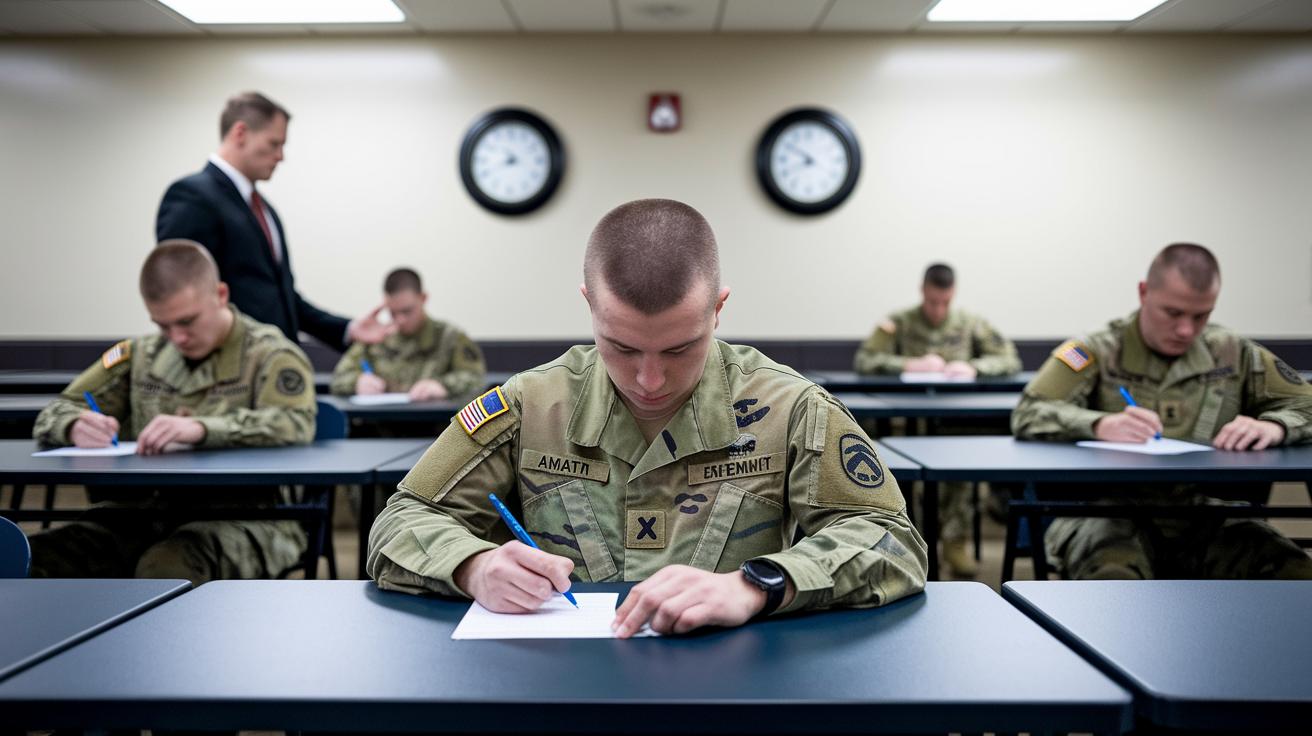
Testing for military aptitude exams takes place at Military Entrance Processing Stations, Military Entrance Test sites, and even some schools. Usually, you'll arrange your test with a recruiter or school coordinator, just like setting up a drill session, so you can choose a spot that’s convenient for you.
If you need to retake your ASVAB, the rules are simple. After your second or third attempt, you wait one month before trying again, giving you time to regroup. And if you need a fourth shot, you'll have to wait six months. Think of it as a chance to catch your breath and prepare better, much like a quick pause before a new exercise.
This system makes sure everyone has a fair share of time to build up their skills step by step.
Using Military Aptitude Test Results to Explore Career Paths

The ASVAB Career Exploration Program (CEP) sets you up with free tests and handy planning tools that help you zero in on the right career options. Your subtest scores reveal where you shine among over 480 military job specialties, and even show you some matching civilian roles. So if you're nailing the technical sections, you might see doors open in aviation or other high-tech fields across different branches.
Picture checking your score report and spotting strong marks in spatial reasoning and mechanical comprehension. That clear sign can point you towards roles in branches known for technical or engineering work. Recruiters use these scores to line up your natural strengths with the right positions, ensuring you’re set up to succeed.
Your ASVAB results are like a personal map for your future. They highlight the areas you might focus on, similar to how a scout checks the terrain before a drill. With CEP’s tools, you get a clearer picture of how your skills match various roles. Whether you opt for a military career or a related civilian path, your score report isn’t just a bunch of numbers, it’s your guide to boosting future success.
Final Words
In the action, we covered what military aptitude tests are, how different formats work, and the scores that matter most. We broke down test types, shared prep strategies, and explained scheduling details in clear terms.
This recap reminds us that with careful study and practice, success in military aptitude tests is within reach. Stay focused, use the tools at hand, and move ahead with confidence for a solid start in your military career.
FAQ
Are military aptitude tests free?
The military aptitude tests are typically offered at no cost by testing centers and recruiters, with many free resources available online to help you prepare effectively.
How do ASVAB practice tests, including free versions, help in exam preparation?
The ASVAB practice tests mimic the actual exam conditions, helping you identify skill gaps, build confidence, and assess readiness by offering targeted feedback through both free and paid versions.
Can I find military aptitude tests in PDF format?
Military aptitude tests in PDF format are accessible from official websites and reputable prep resources, allowing you to download and study offline with ease.
What is the ASVAB test?
The ASVAB test is a standardized exam used by the military to gauge a candidate’s abilities in key subject areas, influencing enlistment eligibility and career placement within various branches.
How does the Army use the ASVAB practice test?
The Army uses ASVAB practice tests to help aspiring enlistees understand the exam format, refine their skills, and ensure they meet the standards required for successful enlistment.
Where can I find ASVAB test questions and answers?
ASVAB test questions and answers can be found in study guides, online prep courses, and practice test resources that provide clear explanations to boost your understanding.
What is the ASVAB test in high school?
The ASVAB test in high school introduces students to military aptitude evaluations, helping them explore career options and assess their potential for future military training and occupational roles.
What is a good ASVAB score?
A good ASVAB score varies by branch, but generally a score above 65 on the AFQT portion is considered competitive and opens up a wide range of enlistment and job opportunities.
What are the 10 tests on the ASVAB?
The ASVAB consists of 10 subtests covering areas such as arithmetic reasoning, word knowledge, paragraph comprehension, mathematics knowledge, general science, electronics information, auto and shop information, mechanical comprehension, assembling objects, and verbal expression.
Is the ASVAB harder than the SAT?
The ASVAB is not directly harder than the SAT, as it focuses on technical and aptitude skills relevant to military roles, while the SAT is designed to measure academic readiness for college.
Is 70 a good ASVAB score?
A score of 70 is typically considered competitive, as it usually qualifies you for more job options and indicates strong performance in the skills assessed by the military aptitude tests.