
Have you ever wondered what really goes on behind your ASVAB scores? It might sound mysterious at first, but the way your test is scored is pretty straightforward. Think of it like a relay race, each part of the exam passes the baton closer to your ideal military job.
Every point you earn helps guide you to a job that suits your skills perfectly. In this article, we break down the scores in simple terms and show you how they can unlock new opportunities in your military career.
Overview of Military Entrance Exam Scoring Explained

The ASVAB is a common test composed of nine parts covering subjects like General Science, Arithmetic Reasoning, and Word Knowledge. In each part, you earn a score from 0 to 100 based on how many answers you get right compared to a typical group. These scores are then used to create a composite score that helps match you with the right military job. For example, if you excel in Word Knowledge and Paragraph Comprehension, your combined score will be boosted for jobs in clerical or administrative fields.
The AFQT score comes from just four of these parts: Word Knowledge, Paragraph Comprehension, Arithmetic Reasoning, and Mathematics Knowledge. This score is then turned into a percentile from 1 to 99. If you score a 60, it means you did better than 60 percent of all test-takers, in other words, you outperformed 60 out of every 100 people. This simple ranking guides recruiters in seeing if you meet the basic requirements and which military jobs might be a match for you.
Each branch of the military sets its own minimum AFQT score, and these requirements can differ a lot. Generally, candidates with a high school diploma need lower scores than those with a GED. Also, your scores stay valid for two years. If you have to retake the test, you'll need to wait 30 days after your first two tries and 6 months after the third. Fun fact: scoring 99% on the AFQT can open doors to exclusive positions, reminding you that every point plays a key role in your military career.
Breakdown of Subtest and Composite Scores in Military Entrance Exam

The ASVAB exam has nine parts, each checking a different skill, just like different drills in the field. Your score in each part ranges from 0 to 100. It shows how many answers you got right compared to a standard group.
A high score in Arithmetic Reasoning means you can solve math problems quickly, an important skill for many roles. These scores are set against a norm group to keep things fair. Think of it like finishing a timed drill and then comparing your time with your fellow recruits.
This scoring method helps recruiters see where you excel and where you might need to work a bit harder.
| Subtest | Score Range | Composite Groups |
|---|---|---|
| General Science (GS) | 0-100 | Electronics (EI+MK+GS) |
| Arithmetic Reasoning (AR) | 0-100 | Clerical (WK+PC+AR+MK) |
| Word Knowledge (WK) | 0-100 | Clerical (WK+PC+AR+MK) |
| Paragraph Comprehension (PC) | 0-100 | Clerical (WK+PC+AR+MK) |
| Mathematics Knowledge (MK) | 0-100 | Clerical, Electronics |
| Auto & Shop Information (AS) | 0-100 | Mechanical (MC+EI+AS) |
| Electronics Information (EI) | 0-100 | Mechanical, Electronics |
| Mechanical Comprehension (MC) | 0-100 | Mechanical (MC+EI+AS) |
| Assembling Objects (AO) | 0-100 | Not included in composite |
Next, composite scores are built by combining certain subtest scores to match different military job types. For clerical roles, they take Word Knowledge, Paragraph Comprehension, Arithmetic Reasoning, and Mathematics Knowledge together to see how well you might do. In jobs that focus on technical maintenance, they look at Mechanical Comprehension, Electronics Information, and Auto & Shop Information.
By looking at these combined scores, recruiters can give you a good match for the right job. This system highlights your strengths and shows you which areas might need a little extra practice.
How AFQT Score Determines Eligibility for Enlistment

Your AFQT score comes from adding together raw scores from Word Knowledge, Paragraph Comprehension, Arithmetic Reasoning, and Mathematics Knowledge. That total is then turned into a percentile between 1 and 99. In simple terms, if you earn a score of 60, you outperformed 60 out of every 100 candidates.
Each military branch uses these scores to check if you meet enlistment standards and to help match you with the right job. Over time, these requirements have changed. For example, those holding a GED need higher scores than high school graduates. Every branch applies these scores a bit differently, which can affect your job placement and career growth.
| Step | Information |
|---|---|
| 1 | Add the raw scores from Word Knowledge, Paragraph Comprehension, Arithmetic Reasoning, and Mathematics Knowledge. |
| 2 | Convert the total to a percentile score (between 1 and 99). |
| 3 | The Army requires a minimum score of 31 for high school diploma holders and 50 for GED holders. |
| 4 | The Marines require at least a 32 and the Navy needs a 35. |
| 5 | The Air Force and Coast Guard set their requirements at 36 and 40, respectively. |
Interpreting Composite Scores for Military Career Paths
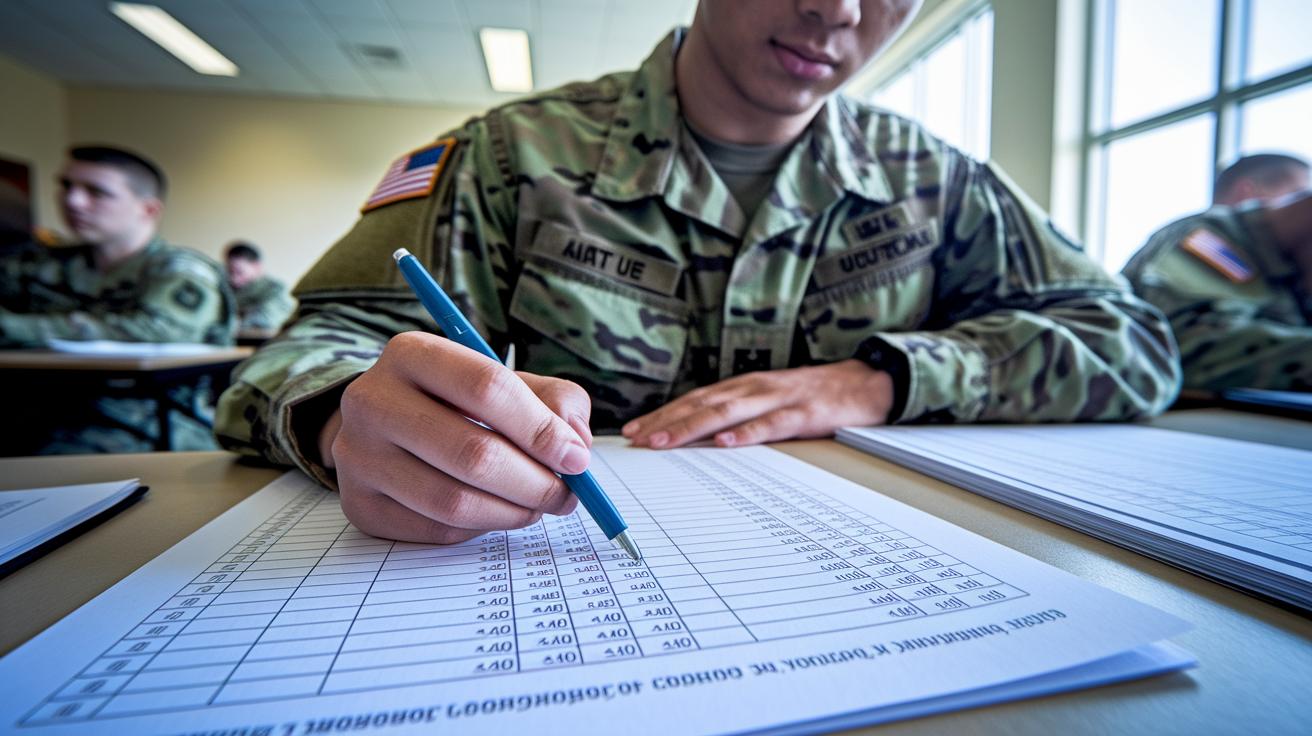
Composite scores give you a quick look at how well your abilities match different military jobs. The General Technical (GT) composite comes from tests like Word Knowledge and Paragraph Comprehension and is key for intelligence roles. For instance, a recruit scoring 112 in GT often shows they have what it takes to excel in top intelligence units. The clerical composite, which mixes VE, AR, MK, and PC, helps figure out who fits best in office or support jobs. Focus your study on the subtests that align with the career you’re aiming for.
The mechanical composite, built from MC, EI, and AS, is tailored for jobs in equipment maintenance, while the electronics composite (EI, MK, GS) paves the way to technical roles in electronics. Some advanced military fields expect a GT score of 110 or more, so there’s a clear need for extra preparation. Work on these key subtests to meet the specific demands of your chosen path.
| Composite Type | Subtests Included | Typical Job Examples |
|---|---|---|
| General Technical (GT) | WK + PC | Intelligence, analytical roles |
| Clerical | VE + AR + MK + PC | Office, administrative support |
| Mechanical | MC + EI + AS | Equipment, maintenance specialties |
| Electronics | EI + MK + GS | Technical electronics jobs |
Strategies to Improve Military Entrance Exam Scores

When you're getting ready for the exam, it helps to focus on the parts that match the military job you want. If you’re aiming for a technical role, spend some extra time on Arithmetic Reasoning and Mathematics Knowledge (basically, how well you can work with numbers). Think of official practice tests like a rehearsal before a drill, reviewing the answers can show you where you can improve.
It also makes sense to set aside time every day for vocabulary practice. Doing drills for Word Knowledge and Paragraph Comprehension not only builds your skills but can boost your AFQT score over time. And remember, the exam has strict rules for retesting. You need to wait 30 days between your first two tries, and after your third try, you wait 6 months. This means your study plan has to be smart and steady. There are more tips on military exam strategies and ASVAB practice questions if you need extra guidance.
Here are some practical tips to help you improve:
- Study the test sections that match the skills needed for your chosen military job.
- Use official practice tests and take time to go over every explanation.
- Do regular vocabulary drills for Word Knowledge and Paragraph Comprehension.
- Practice Arithmetic Reasoning and Mathematics Knowledge under timed conditions.
- Set up a study schedule that mimics the pacing on exam day.
- Keep the retesting rules in mind: 30 days between the first two tests and 6 months after the third.
Stick to these steps, and you'll find your readiness growing with every study session, just like preparing for a well-planned mission.
Frequently Asked Questions on Military Entrance Exam Scoring Explained

-
What are common misconceptions about AFQT scores?
Some think the AFQT score shows your entire potential. In truth, it’s just a look at your current skills, which you can improve with practice. I’ve seen people stick with a 60 and believe that’s as high as they can go, but steady study can really boost your numbers. -
What exam preparation tips can boost your performance?
Set up a clear study plan and focus on the areas where you struggle. For example, work on arithmetic reasoning by using everyday tasks like budgeting small amounts. This practical drill can really sharpen your skills. -
How can you use your composite score data effectively?
Take a close look at each subtest and find the ones that need more work. If your word knowledge is low, try spending extra time with vocabulary exercises. This targeted practice can give your overall score a nice lift. -
How should you interpret your percentile ranking?
Your percentile tells you how you performed compared to others, it shows a relative ranking, not your full ability. For instance, if you’re at the 60th percentile, you did better than 60 percent of candidates, but that’s not the whole picture of your potential. -
What strategies can help after a retake?
After a retake, use the waiting period to go over your mistakes and review topics that challenged you. Write down the questions you missed and work on similar problems. This focused review can really strengthen your understanding. -
What mindset is best during the exam process?
It helps to aim for steady improvement rather than stressing about one score. Treat each exam like a drill, building your skills bit by bit. Keeping a progress journal can be a great way to see how small gains add up over time.
Final Words
In the action, we broke down how test scores work, from ASVAB subtests and composite evaluations to AFQT percentiles and branch requirements. The post covered practical strategies to boost performance and answered common questions to clear up any confusion. It gave a straightforward look at steps for study and preparation so you can advance confidently. Stay focused, keep practicing, and remember that military entrance exam scoring explained offers the roadmap to success.
FAQ
What does military entrance exam scoring explained (Army, 2020, 2022) mean?
The military entrance exam scoring explained shows how the Army uses standard scores from nine subtests and composite scores to qualify you. It remains consistent over recent years with expected updates.
What jobs do I qualify for with my ASVAB score?
The ASVAB score guides which military jobs fit you by aligning your composite scores with specific roles. It helps match your strengths to qualified occupational specialties.
What does AFQT score meaning imply?
The AFQT score meaning reflects your percentile compared to others, based on four key subtests. It shows whether you meet the basic eligibility requirements for service.
What do ASVAB composite scores meaning indicate?
The ASVAB composite scores meaning indicates totals from selected subtests used to qualify you for different job fields. They signal your potential performance in specific military roles.
What do ASVAB standard scores meaning represent?
The ASVAB standard scores meaning represents scores scaled from 0 to 100 based on your correct answers. They provide a clear measure of your abilities in each test section.
What is the PiCAT score chart meaning?
The PiCAT score chart meaning translates computer test results into ASVAB equivalent scores, offering an easy-to-read guide on your aptitude across various skills.
What is a good score on the military entrance exam, and is 70 a good score while 25 is bad?
A good military exam score often features an AFQT of 60+; in composite scoring, a 70 is competitive, whereas a 25 is considerably low and may limit your service options.
How to interpret ASVAB scores?
Interpreting ASVAB scores means comparing your standard and composite numbers with branch-specific benchmarks. This helps determine your strengths and the military roles that suit you best.