Have you ever wondered if your workout is up to real military standards? Regular gym routines might not build the focus and strength you really need. Military-style training mixes fast-paced drills with specific bodyweight exercises, much like the energy you feel during an early-morning base workout.
These exercises build muscle, improve your balance, and sharpen your mental focus. They get you ready for any challenge that comes your way. In this post, we break down simple routines that work both your body and mind, showing you a clear path to real power and control in your training.
Top Military Fitness Exercise Routines for Building Strength and Endurance

A sound military workout blends exercises that boost your muscle power, stamina, and core balance. These free, military-style sessions include drills that feel like real combat preparation, think of the brisk energy of an early-morning drill mixed with the focused intensity of a field exercise. Each routine is designed to work different parts of your body, from quick heart-pumping moves to controlled strength exercises, helping you develop resilience and overall readiness. Whether you're training on your own or with a buddy, these circuits get you ready for the physical demands of military service.
- Jumping Jack Fury – a lively warm-up routine using a set pattern of jumping jacks to fire up your whole body.
- Circuit Crusher – a mix of rowing, kettlebell swings, push-ups, and crunches that builds endurance and a strong core.
- Rope Rampage – a workout that targets upper-body power and cardio using fast-paced battle rope actions.
- Core Destruction – focuses on core stability with moves like reverse crunches, plank knee-ins, and heel touches.
- Bike Blast – pairs Assault Bike sprints with dumbbell step-ups to create explosive strength in your legs.
- Bodyweight Surge – uses bodyweight moves like dive bomber push-ups and split jumps to boost overall conditioning.
- Burpee Blitz – a high-energy routine featuring burpee pyramids, mixed with V-ups and extra drills.
- Row Inferno – builds full-body strength with a blend of rowing, dumbbell thrusters, and Russian twists.
- Cardio Core Crusher – combines mountain climbers, planks, tuck jumps, and side plank dips for both a heart boost and a strong core.
Rotating these routines keeps your workouts fresh and balanced. They help you build power, endurance, and discipline, setting you up for success in the field.
Tactical Conditioning Drills: HIIT and Bodyweight Circuits

In this section, we go beyond the basic workout overviews and offer clear, down-to-earth guidance on designing high-intensity tactical circuits. Think of drills like Circuit Crusher, Bodyweight Surge, and Cardio Core Crusher as your new go-to moves to get those quick anaerobic bursts with controlled recovery.
Work-to-Rest Strategies
We all know that how you work matters just as much as how you rest. Common ratios like 20 seconds on with 10 seconds off (kind of like Tabata), a 1:2 ratio, or even 2:1 are key. The 20s:10s rhythm really fires up your anaerobic system, while taking twice as long to recover helps ensure your muscles get the break they need. Picture a soldier doing kettlebell swings for 20 seconds and then grabbing 10 seconds to catch a breath, it's a rapid-fire drill that builds explosive power.
Exercise Sequencing and Tempo
Planning your exercises in the right order means letting one muscle group rest while another gets to work hard. By setting a tempo, say, 3 seconds to lower the weight and 1 second to lift it, you keep your muscles under tension just long enough to make every rep count. It’s like executing a tactical move where timing is everything.
Advanced Variations and Modifications
To keep things challenging, try adding plyometric moves or tweaking your equipment. Changing up the tempo or the volume of your workout lets you ramp up the intensity as your skills improve, similar to adjusting mission details on the field.
Using these drills will boost your power, strengthen your core, and sharpen your overall conditioning, setting you up for better performance both on and off the field.
Specialized Endurance Programs and Field Obstacle Challenges

This 30-day program is built like a mission drill. You work out with bodyweight circuits in tight spaces to mimic the real field. It mixes hard, functional moves that match special operations training, helping you boost both your endurance and mental toughness.
The plan includes:
- Alternative running/agility drills – These are at-home cardio routines that mix up running patterns and quick directional changes to sharpen your responsiveness and foot quickness.
- Ruck marches – These loaded walks build muscle endurance and mental grit by simulating the weight you’d carry during long field missions.
- Obstacle sprint modules – These track sprints include hurdles that feel like real-world challenges, helping you make fast decisions and burst into explosive speed.
Mixing these drills challenges your body in different ways. The running drills improve your agility and quickness. Ruck marches build the strength you need for long missions. And the obstacle sprints boost those rapid reflexes for unpredictable situations. All together, these exercises create a well-rounded routine that prepares you for any demanding mission.
Strength Conditioning: Load-Based Workouts and Calisthenics

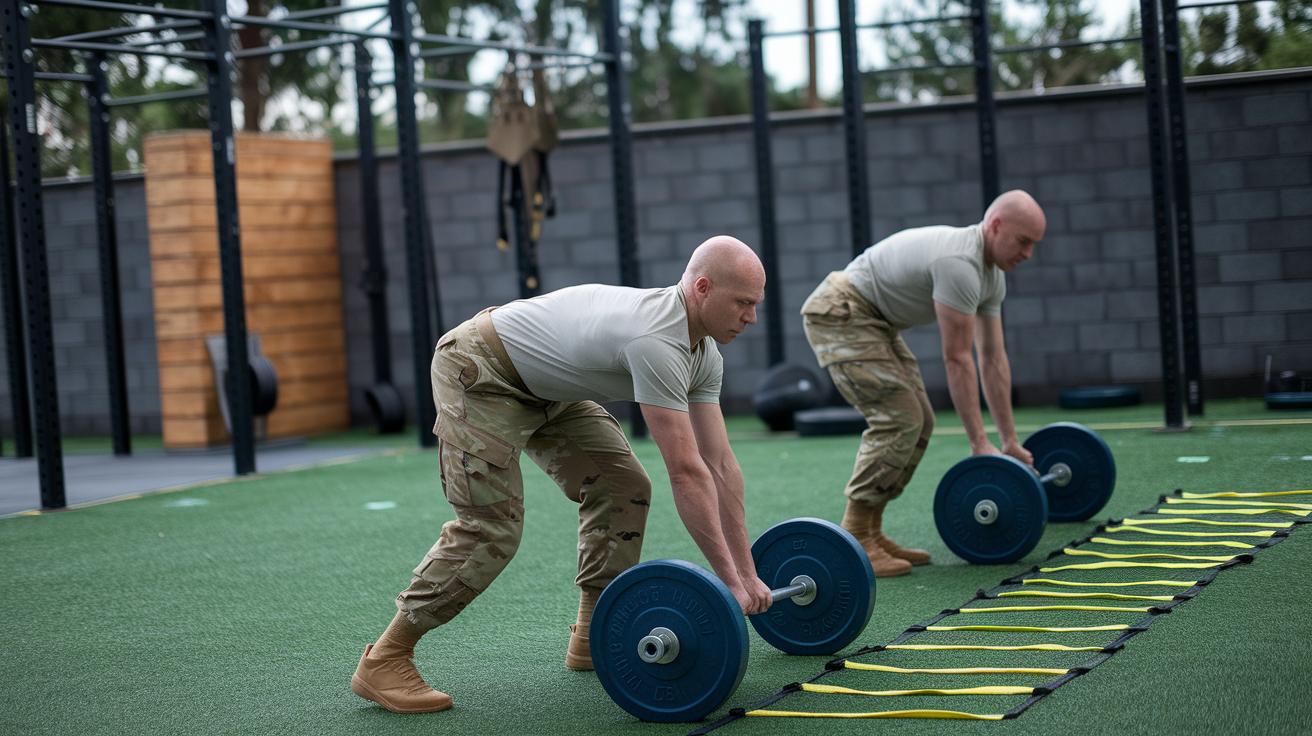
Mixing heavy lifts with bodyweight moves builds solid muscle and the real-life strength needed for military work. When you add exercises like barbell back squats, deadlifts, bench presses, military presses, thrusters, and lunges to drills such as push-ups, pull-ups, burpees, farmer’s walks, and planks, you train your whole body. It’s a lot like boot camp, where every rep sets the pace for a demanding mission, building resilience and discipline along the way.
Compound Movements
Compound moves work several muscle groups at once. Try going for 3–5 sets of 6–12 reps on core lifts like the barbell back squat or bench press. These exercises boost overall strength by getting muscles to work together, much like a team pulling off a mission.
Bodyweight Drills
Bodyweight drills help fine-tune your form and build endurance. Practice push-ups, pull-ups, and burpees for 15–25 reps each set. Keep your body aligned and your motions controlled, each move becomes a tactical step toward better fitness.
| Focus Area | Exercise & Reps | ||||||||||||||||||
|---|---|---|---|---|---|---|---|---|---|---|---|---|---|---|---|---|---|---|---|
| Lower-body strength | Squats, deadlifts, lunges – 3 sets of 8–10 reps |


| Benefit | Tip to Add |
|---|---|
| Physical Fitness | Alternate between strength and cardio to build steady, full-body endurance. |
| Mental Resilience | Plan tough drills with breaks to keep your focus sharp and your spirit strong. |
| Teamwork and Camaraderie | Include partner drills and group workouts to build trust and support among your team. |
Adding proper recovery techniques is key. After each session, include mobility work like dynamic stretching and joint exercises to ease muscle tension and avoid injuries. Adjust your plan based on how you feel and treat rest days just as seriously as your drills. This balanced approach builds true strength and the discipline that lasts for the long haul.
Tracking Progress and Preparing for Military Fitness Tests

Keeping track of how you're doing is key to meeting the fitness standards in the service. It doesn't matter if you're timing your 1.5-mile run, counting push-ups, pull-ups, or sit-ups, or checking your plank hold, each benchmark shows where you stand and what you need to work on for branches like the Army, Navy, and Marines. Using branch-specific charts, like the ones at Military Aptitude Tests (https://militaryaptitudetests.com?p=164), gives you clear targets to hit and helps shape your training plan.
| Metric | Purpose |
|---|---|
| Timed runs | Monitor your aerobic endurance |
| Reps for push-ups, pull-ups, and sit-ups | Gauge muscular strength and stamina |
| Distance benchmarks | Boost running and marching stamina |
| Heart-rate zones | Track cardio efficiency |
Setting SMART goals is a smart way to push your limits bit by bit. Think of your test-day strategies like planning a mission: pace yourself, make sure you're well-rested, and keep focused. Regularly retesting lets you tweak your workouts and see steady improvements. This steady approach builds your strength and discipline, preparing you to tackle any challenge head-on.
Final Words
In the action, we covered a range of military fitness exercises, from free routines like Jumping Jack Fury to tactical HIIT and strength conditioning drills. We broke down modifications for all levels and shared tips for balancing rigorous workouts with recovery.
This article outlines practical strategies to boost strength, agility, and overall test readiness. Keep rotating these routines to build both body and mind. Stay focused and keep pushing forward, success is always just one drill away.
FAQ
Are military fitness exercises and workout program PDFs available?
The military fitness exercises PDF offers downloadable, structured routines that detail strength, endurance, and combat readiness drills, making it easy to follow training plans and adjust for different fitness levels.
What do military fitness exercises for beginners include?
Military fitness exercises for beginners include basic bodyweight moves and light cardio drills that build strength and stability, providing a solid foundation for more demanding workouts later on.
What does an 8-week military fitness program involve?
An 8-week military fitness program provides a step-by-step plan that blends strength, cardio, and core routines to progressively boost endurance, power, and overall fitness over the course of two months.
How can I perform military fitness exercises at home?
Military fitness exercises at home adapt combat readiness drills to a small space using bodyweight circuits and simple equipment, allowing you to develop strength, core stability, and aerobic capacity without a gym.
How do military fitness exercises with dumbbells work?
Military fitness exercises with dumbbells merge resistance training with functional movements, combining lifts and stability drills to build muscle strength and improve readiness for field challenges.
What are some of the best military fitness exercises?
The best military fitness exercises target functional strength, endurance, and agility by incorporating compound movements, bodyweight drills, and high-intensity intervals that mirror real-life physical demands.
What type of exercise is best for the military?
The best exercise for the military includes a mix of strength training, bodyweight routines, and high-intensity cardio circuits, ensuring you develop overall physical preparedness for rigorous field activities.
What does the 3-3-3 rule for workouts mean?
The 3-3-3 rule means performing sets that include 3 rounds of 3 different exercises, which helps keep routines concise while building balanced strength and endurance throughout your workout.
What is the 7 minute military exercise?
The 7 minute military exercise is a fast-paced circuit that combines several bodyweight movements in a short timeframe, aiming to boost cardio, muscle endurance, and overall fitness quickly in a time-efficient way.
What does the 6-12-25 rule signify in military workouts?
The 6-12-25 rule signifies a method where you perform 6 reps at a heavy load, 12 at a moderate load, and 25 at a lighter load, creating a balanced workout that builds strength, power, and muscular endurance.
Related articles