
Have you ever wondered if military promotion exams are more than just stacks of paperwork? These tests are designed to show off your skills and help you move forward. The written exam is like a brief report that covers the basics, while the oral and hands-on tasks let you demonstrate your leadership and quick thinking (how fast you can decide on a strategy).
In this article, we break down each type of test so you know what to expect and can prepare smartly for the next step in your career.
Key Components of Military Promotion Exam Formats
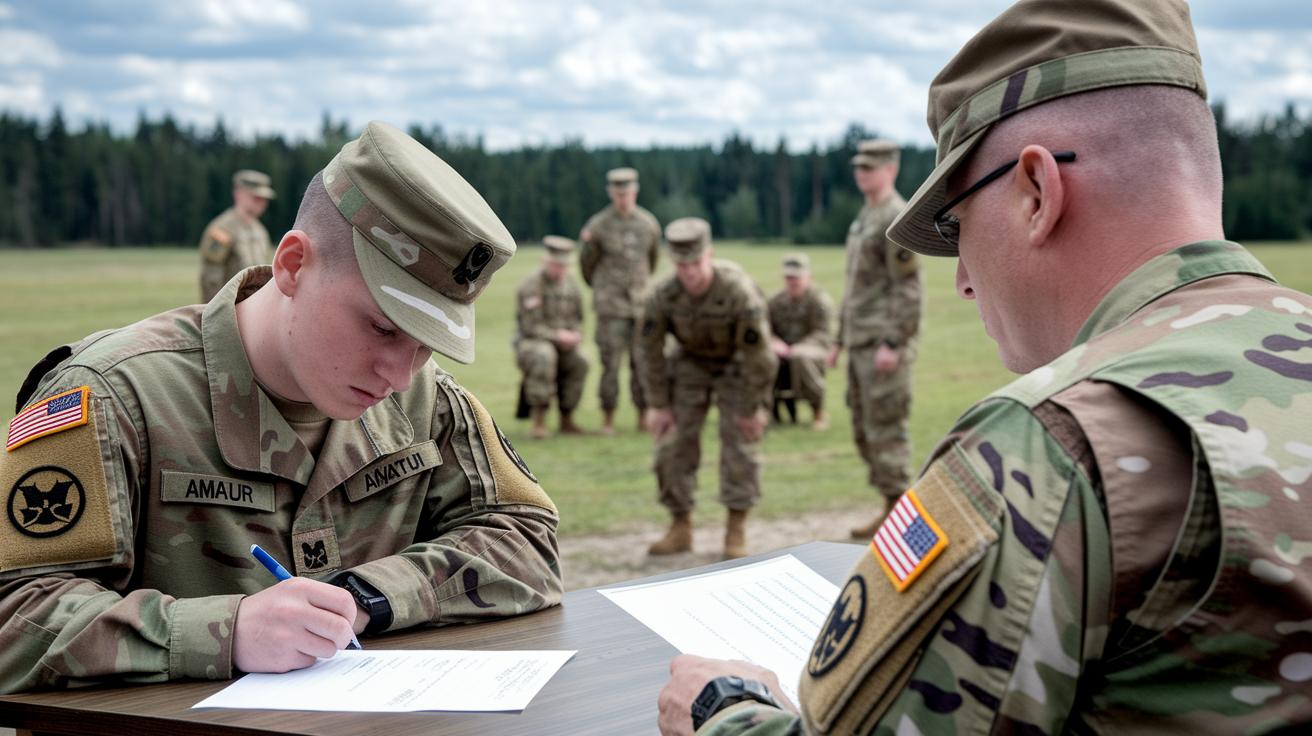
When you’re preparing for a military promotion, expect exams built to check your skills and readiness. Written tests usually have multiple-choice questions about regulations, technical duties, and leadership guidelines. They make sure you understand the basics needed to move up in rank. Oral evaluations throw scenario-based questions your way, so you can show off your communication and quick decision-making skills. And then there are practical tasks that simulate real-life missions, giving you a chance to prove your abilities under pressure. Think of a written exam like a brief, clear after-action report that covers all the important steps.
Each type of test has its own role:
- Written: Checks your fundamental knowledge of military policies.
- Oral: Reviews your leadership and quick-thinking abilities.
- Practical: Measures how well you apply your skills in simulated mission-critical scenarios.
These exam parts tie directly into your career progress. For example, enlisted soldiers start at E-1 and can move up to E-2 after about six months, then to E-3 after roughly a year, as you meet specific benchmarks. When you move from technical roles into leadership, like rising from Specialist to Corporal, the practical test becomes even more significant. At mid-to-senior levels, oral evaluations focus on your ability to lead teams, reflecting the heavier responsibilities of commanding a platoon or company. All these testing pieces work together to match your advancing duties and time in service.
Promotion Exam Structures by Rank Group

Enlisted soldiers usually move up the ladder by meeting time and performance goals. When you progress from E-1 to E-3, it's mainly about fulfilling service time and performance standards. But once you hit E-4, like moving from Specialist to Corporal, you need to pass a written exam that shows off your technical know-how and budding leadership skills. Think of it like a quick checkup to prove you're ready for extra responsibility, much like a drill sergeant noticing your steady effort during training.
Warrant officer candidates follow a different path. As you advance from W-1 to W-5, the exam boards focus on your technical skills. These panels ask specific questions and use practical scenarios to test your expertise, similar to how a mechanic ensures every tool is in tip-top shape. Here, the tool is your deep understanding of the technical aspects of your role.
Officer promotions mix time in grade with formal exams. A Second Lieutenant typically becomes a First Lieutenant after about 18 to 24 months, then works toward becoming a Captain through additional tests and competitive selections. These exams combine written knowledge with real-life scenarios, much like rehearsing a strategic plan before heading into the field. Every detail counts when you're preparing to lead a team.
In short, enlisted promotions rely heavily on meeting time and performance benchmarks, warrant officer exams center on technical skills, and officer promotions combine time served with rigorous testing. Each track has its own set of clear eligibility rules and exam requirements that match the unique demands of the rank group.
Written Assessment Design Details in Promotion Exams

Written tests for military promotions are built to mirror real duty challenges you might face. Most exams feature about 100 to 120 multiple-choice questions covering topics like service regulations (the rules everyone must follow), everyday technical tasks, and leadership methods. This format makes sure you clearly understand key military procedures and can make smart, quick choices on the field. Both senior NCOs and future officers tackle assessments that match the demands of their jobs, proving they’re ready for more responsibility.
- Service regulations – checks your grip on military policies and orders.
- Technical scenarios – tests your knowledge of daily technical tasks.
- Leadership principles – looks at how well you can guide a team.
- Analytical puzzles – measures your problem-solving skills using small-unit tactics.
- Essay prompts – give you space to express deeper critical thinking.
Time limits are a critical part of these assessments. You usually get around 60 minutes to work through the multiple-choice section, forcing you to think fast while still considering your answers. In some cases, exams for senior NCOs and officers add one or two 30-minute essay sections to dive deeper into leadership and strategic planning. This mix of rapid-fire questions and thoughtful essays reflects the real balance between quick decision-making and careful planning on the ground. Overall, these tests make sure every leader has both the technical know-how and strategic insight needed to face the challenges ahead.
Oral Evaluation Format Insights in Military Promotion Exams

These evaluation boards are set up to match the different leadership roles required at various ranks. For example, NCO oral boards (for E-7 to E-9) check if you can lead a team of 8 to 16 soldiers and act as a trusted senior adviser. Warrant officer panels test your technical know-how as you move from WO1 to CW5. For officers, the promotion boards examine your command decisions, whether you’re guiding a company or a platoon. In each case, experienced evaluators use real-life scenarios to see if you’re ready for the next step.
Scoring is based on clear criteria that consider your leadership potential and decision-making under pressure. The board is usually made up of senior leaders from your field, which means the feedback reflects actual challenges you face on the job. The oral evaluation follows a set order to help you show off your skills in a steady way:
- Pre-board brief: You get a rundown of what to expect.
- Panel questioning: You answer clear, scenario-based questions.
- Scenario responses: You demonstrate your understanding of real-life situations.
- Score submission: Evaluators write down how you performed.
You usually get feedback right after the board, which gives you useful insights to help guide your next steps.
Practical Skills Testing Structure for Rank Advancement

These evaluations are designed to mirror real-life challenges. Imagine you're leading a squad or handling technical equipment on the field. You face tasks that ask you to think fast and act right away, much like you would during an unexpected mission.
In each test, you'll encounter stations that simulate real operations. This means you'll need to make quick calls while keeping track of important details. Each station highlights a different skill crucial for the job.
- Tactical decision games – These put you in fast-changing scenarios to check if you can quickly pick the best plan.
- Technical equipment tasks – Here, you'll work with military machinery, focusing on details to operate or fix them if needed.
- Leadership reaction exercises – These tests see how fast and well you can lead a team during surprise events.
Each station has clear performance measures. They are set up to show not just your knowledge of standard procedures, but also your ability to make fast, accurate decisions under pressure. Doing well here shows that you can handle the stress and responsibilities of managing a team or complex systems on the field.
Scoring System and Sectional Weightage in Promotion Tests

Scoring in promotion tests shows what you know and how you handle tough decisions and hands-on tasks. The written part makes up 50 to 70% of your score and checks your grasp of military rules and technical tasks. The oral part, which carries 20 to 30%, gives you a chance to show your leadership and quick thinking in scenario-based questions. Practical tasks simulate real-world challenges and add 10 to 20% to your overall score. Plus, time limits are key, like when you have 100 multiple-choice questions to finish in 60 minutes, so you have to be both accurate and fast.
| Exam Segment | Weightage | Time Limit |
|---|---|---|
| Written | 50-70% | 60 minutes |
| Oral | 20-30% | Varies |
| Practical | 10-20% | Varies |
When you add these parts together, they decide if you're ready for promotion. Your overall performance isn’t based on one area alone; it also includes your exam results, regular evaluations, and time served. This balanced plan makes sure every part of the test counts fair and square, matching our clear standards for moving up. So, if you study every segment thoroughly, you'll be set to meet the benchmarks for promotion.
Preparation Tactics for Military Promotion Exam Formats

Your study plan should be tailored to your service record and the challenges you face as you move up. Think of every study session as a mini-mission that sharpens your skills for the next step. For example, if you're aiming for Sergeant, focus on small-unit tactics. Officers, on the other hand, need to practice managing platoon command for groups ranging from 16 to 44 soldiers. Each drill builds on the last, so you keep progressing without missing a beat.
Keeping track of your milestones is key. With every new rank comes fresh duties, which means tweaking your study plan along the way. Simulation drills and practice exams help you get used to the pressure you’ll face on test day. The closer your practice tests are to the real thing, the more ready you'll be when it counts. This steady, methodical approach links your daily routines to your long-term career goals.
| Study Tactic | What It Does |
|---|---|
| Daily regulation quizzes | Tests your knowledge of core military guidelines. |
| Timed mock tests | Builds your ability to respond quickly under exam conditions. |
| Peer coaching | Uses a buddy system to pinpoint strengths and areas to improve. |
| Scenario drills | Puts you in realistic situations that challenge your decision-making skills. |
| Essay practice | Helps you express your ideas clearly during long response tasks. |
| Oral board rehearsals | Prepares you to speak confidently in front of evaluators. |
| Stress-management techniques | Teaches you how to stay calm during high-pressure tasks. |
Each tactic lines up with a specific exam format. Daily quizzes and timed tests hone your skills for the written part, while scenario drills and oral board rehearsals prepare you for the practical and spoken challenges. Peer coaching and essay practice help you refine your strategic thinking for leadership roles. By using these focused steps, you can approach your promotion exam with the confidence of a soldier who’s well-prepared and ready to tackle the challenge.
Final Words
In the action, we broke down the exam process into clear segments, written, oral, and practical, to help you see how each part tests specific military skills. We reviewed exam components based on rank groups, time-in-grade requirements, and performance metrics.
This article aims to give you a straightforward guide for boosting both mental clarity and physical readiness. With these strategies in hand, good luck on your path to success and solid understanding military promotion exam formats. Stay focused, and keep moving forward.
FAQ
Q: What does PDG Study Guide TSgt 2025 and Air Force Staff Sergeant Study Guide 2025 offer?
A: The PDG Study Guide TSgt 2025 and Air Force Staff Sergeant Study Guide 2025 offer concise details on exam content, rank requirements, and test strategies to help candidates prepare effectively for promotion boards.
Q: What is PDG GOLD?
A: PDG GOLD is a specialized resource that compiles preparation tips and study materials for Air Force promotion exams, assisting candidates in reviewing key topics and exam formats efficiently.
Q: What does TSgt rank or Technical Sergeant in the Air Force mean?
A: TSgt rank, also known as Technical Sergeant, signifies a mid-level leadership role in the Air Force where individuals take on greater technical responsibilities and supervise junior enlisted personnel.
Q: What are typical Air Force promotion board questions?
A: Air Force promotion board questions cover topics like leadership abilities, regulations, and tactical operations, helping assess a candidate’s readiness to assume higher responsibilities.
Q: What does test compromise mean in the Air Force?
A: Test compromise involves safeguards designed to prevent cheating and maintain fair testing conditions during Air Force promotion exams, ensuring all candidates are evaluated on a level playing field.
Q: How do Army promotion boards work?
A: Army promotion boards work by assessing a soldier’s performance through interviews, written exams, and evaluations, focusing on leadership skills, job knowledge, and time-in-grade achievements.
Q: How long does it take to advance from E2 to E3 in the military?
A: Advancing from E2 to E3 usually takes about one year of service, allowing soldiers to gain the necessary experience and meet the performance criteria for the next rank.
Q: How many promotion points are needed to reach E6?
A: Reaching E6 depends on accumulating a set number of promotion points, which are earned through exams, evaluations, and demonstrated leadership, with specific requirements varying by branch.
Q: What are the three types of promotions in the Army?
A: The three types of Army promotions include automatic promotions based on time-in-grade, performance-based promotions through earned evaluations, and competitive selections that involve exam and board approval.