
Ever wonder if choosing the right answer on a military exam is more than just chance? When you work on your decision-making, you give yourself an extra edge. Start by testing yourself early and setting clear goals. That way, your mind learns to think fast under pressure (just like during a quick drill).
Next, take those tough topics and break them into smaller parts. Practice with full-length exams to boost your confidence and speed. Every session, even a small one, isn’t just test prep, it’s training a skill that can really make a difference when seconds count.
Actionable decision-making enhancement strategies for military exam success
When you're gearing up for the ASVAB, start by taking a quick diagnostic test to find out what you excel in and where you might need a bit more work. This first step helps you set clear, achievable weekly goals and lets you tailor your study sessions to focus on trouble spots, whether it’s arithmetic reasoning or mechanical comprehension (that is, understanding how different parts work together).
Full-length, timed practice tests come in handy too. They boost your confidence and get you used to real test conditions, sharpening your ability to make quick, smart decisions when it counts.
Mix your study time with short breaks and try using the process of elimination to narrow down answer choices. This technique not only familiarizes you with the different ASVAB subtests, like word knowledge and paragraph comprehension, but it also builds the skills needed to make rapid decisions under pressure.
- Review your diagnostic test results to set clear priorities.
- Break down study topics into small, manageable sections.
- Simulate real test conditions by practicing with full-length, timed exams.
- Use the process of elimination (for more tips, check out the strategic breakdown of military test question types).
- Don’t be afraid to make educated guesses since no points are taken off for wrong answers.
- Reinforce your decision-making skills with regular, focused review sessions.
- Set weekly milestones to track your progress and adjust your strategy as needed.
Put these strategies into action, and you’ll start to see measurable gains. With diagnostic testing, consistent practice exams, and review sessions built into your routine, you'll notice you’re answering questions faster and with more accuracy. Every decision you make, from pacing yourself on arithmetic challenges to knowing when to guess strategically, adds up to a stronger overall score.
Optimizing cognitive performance for defense assessment decision-making
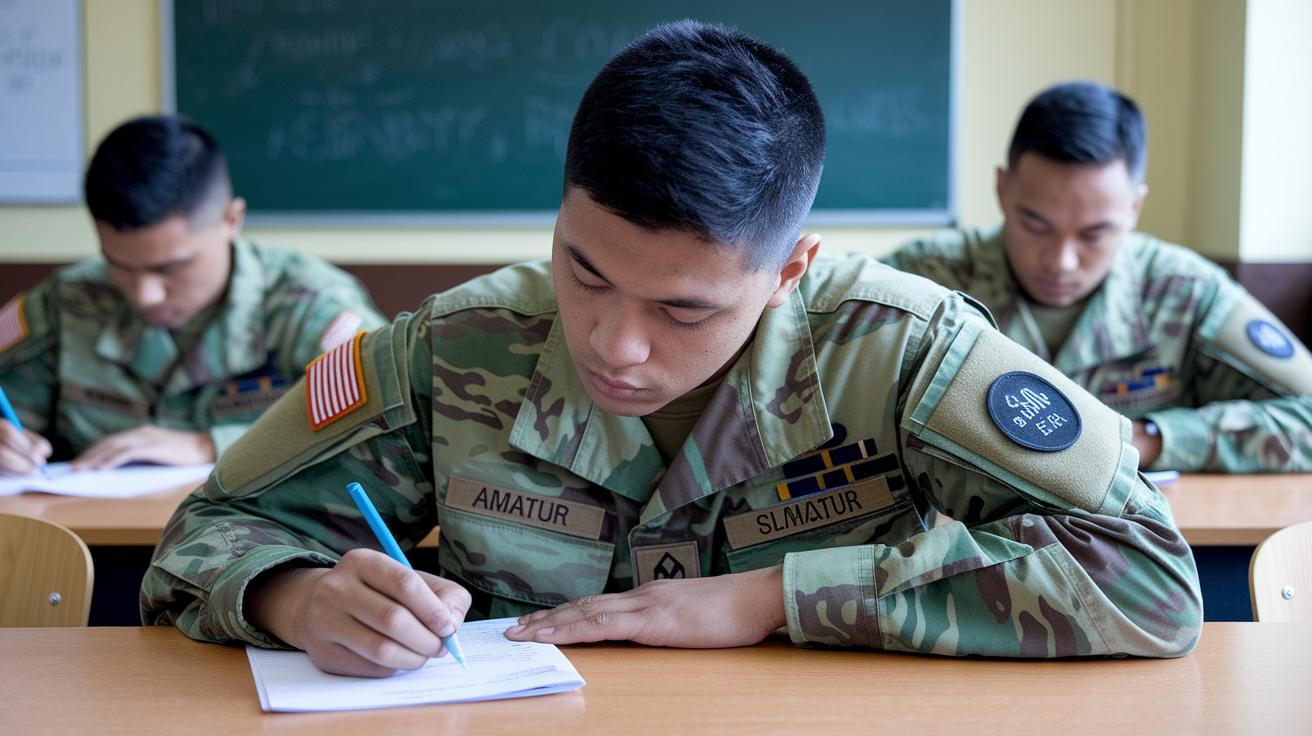
When studying for military exams, structured study sessions can really change the game. Try breaking your study time into 45 to 50-minute blocks, then take a 10 to 15-minute break. It’s like a soldier catching a breath during a well-timed maneuver – it gives your brain the chance to refresh and lock in key info.
Good sleep and breaking tasks into smaller parts work just as well. Aim for 7 to 9 hours of sleep each night, especially before exam day, to keep your focus sharp and help your memory do its thing. And if a topic feels too big, break it down piece by piece, like tackling one obstacle at a time during a training drill. With focused study periods, proper rest, and clear steps, your mind gets stronger, helping you make quick decisions when it counts.
Stress-resilient decision frameworks under high-pressure testing environments
Staying cool under exam pressure starts with simple steps that steady both your mind and body. When you feel your nerves spike, try focusing on your breathing and letting your muscles relax. It’s like giving yourself a quick reset so you can think clearly.
Deep Breathing Techniques
Try practicing slow, timed breathing drills before the test and during the tougher parts. For example, breathe in slowly for a count of four, hold for four, then breathe out steadily for four. This technique works like hitting the pause button, it slows your heart rate and calms any racing thoughts. With regular practice, your body will remember this calm rhythm, ready for when you face a tricky question.
Progressive Muscle Relaxation
Spend about 5 to 7 minutes easing muscle tension. Start at your feet by tensing those muscles for a few seconds, then let them completely relax. Gradually move upward through your legs, torso, arms, and face. Imagine it as loosening tight knots so every muscle can help keep your focus sharp. This method helps reduce physical stress that might pull your attention away from making quick, smart decisions.
Pair these techniques with solid exam-day habits, like arriving 15 to 20 minutes early and having a protein-rich breakfast. Picture yourself tackling each question with a clear, steady mind, that visualization can drive you to make confident, smart decisions throughout your test.
Time management and strategic pacing for accurate decision-making

Managing your time well during the ASVAB can really make all the difference, like planning a clear military mission. Think of the exam as an operation where every part needs careful coordination. Experts say you should split your time based on how hard each section is and how many questions there are. If you know which areas need extra work from your practice tests, add a few more minutes there. Also, plan little check-ins during the test to see if you’re on track, so the clock never surprises you.
| Subtest | Suggested Time Allocation | Decision Approach |
|---|---|---|
| Word Knowledge | 12 minutes | Quick scan and elimination |
| Arithmetic Reasoning | 15 minutes | Step-by-step problem solving |
| Mathematics Knowledge | 14 minutes | Identify familiar formulas |
| Paragraph Comprehension | 13 minutes | Focus on key details and inference |
| Mechanical Comprehension | 16 minutes | Apply logical reasoning |
Using this table while you practice helps you adjust your speed on the fly. Set checkpoints during your exam to check your progress and adjust your time if needed. When you build these habits into your routine, you’ll notice an improvement in both speed and accuracy, and every decision will feel well thought out.
Simulation-based scenario analysis to sharpen tactical reasoning
Simulation drills are a fantastic way to get a feel for exam pressure, much like real battlefield simulations test your on-the-spot decisions. Try to run three to five timed drills each week. These drills can include short scenario sketches where you must quickly pick an action, modules with branching choices that force you to select one of several strategies, or crisis puzzles that demand instant problem-solving. Picture yourself in a simulation where you need to secure an entry point because a comrade spotted unexpected movement. This approach sharpens your instincts for making fast, accurate decisions under pressure.
After each drill, take a few minutes to debrief yourself. Look at simple measures like your response time and accuracy (how quickly and correctly you made a decision) to figure out when a quick, confident choice was needed. For example, think about a time when acting under pressure gave a good result or when a different choice might have worked better. By regularly reviewing these drills, you’ll learn how to balance speed and accuracy and adjust your tactics for future tests. Each debrief helps you spot areas in your decision-making that could use some fine-tuning, ultimately turning practice scenarios into a powerful tool for sharpening your tactical reasoning.
Mindset conditioning and mental agility workouts for rapid judgment

Every day, try a quick 5-minute puzzle or rapid-fire multiple-choice drill to wake up your brain. Research shows that doing 10 to 15 puzzles daily can boost your thinking speed by as much as 20% in just one month. This habit helps you build a tough mind and prepares you to make fast decisions when it counts.
Adaptive Reasoning Drills
Work on puzzles that slowly get harder. Start with simple problems and then move to puzzles that take a few steps to solve. This steady ramp-up makes your brain plan out clear steps and sharpens your ability to solve problems fast. For example, begin with a basic sequence puzzle, and later tackle one where you spot patterns and guess the next step under a time limit.
Pattern Recognition Tasks
Do timed drills that focus on finding both visual and written patterns. Set a timer and work on exercises that ask you to spot repeated sequences or find differences. These tasks train your mind to quickly pick up important clues, which is a huge help when you’re under pressure during a test.
Post-practice evaluation and iterative decision improvement methods
After each test and practice session, it's a good idea to review your results closely. Go through every decision you made and jot down why you chose each answer. This simple habit lets you see if there are any patterns in your mistakes so you can fix your weak spots.
- Review practice tests and note error patterns
- Log why you picked each answer
- Identify repeating issues for targeted fixes
- Compare time spent on questions to refine your pace
- Concentrate on perfecting high-yield strategies instead of picking up brand-new material
When you follow these steps, every review turns into a quick debriefing with yourself, just like discussing a mission with a buddy. It not only brings your recurring mistakes into focus but also shows you how to make decisions faster when it counts. In the week before your exam, concentrate on keeping your pace steady and go over the key ideas highlighted by your review. By tracking your choices and making small improvements, you'll notice real progress that builds your confidence and helps you perform better on exam day.
Final Words
In the action, we reviewed practical methods that boost your readiness, from cognitive workouts to stress-resilient drills and simulation-based tactics. These techniques help you prepare for every section of the test while fine-tuning key skills.
By focusing on clear, step-by-step strategies and consistent practice, you build the mental and physical agility needed. Keep working on these decision-making enhancement strategies for military exams, and let your preparation rock your performance with confidence and determination.
FAQ
What is the military decision making process PDF?
The military decision making process PDF provides a written guide that explains each step of structured planning, from mission analysis to decision implementation, clearly outlining roles and procedures.
What does military decision making process training involve?
The military decision making process training teaches service members a set of organized steps to evaluate options and plan actions. It includes hands-on exercises that simulate real decision environments.
How does a military decision making process PowerPoint help?
The military decision making process PowerPoint serves as a visual aid that breaks down each planning stage, offering diagrams and key points to enhance understanding of operational choices.
Who is the most important participant in the military decision making process?
The most important participant in the military decision making process is the commander, who leads the planning, sets objectives, and ensures that every decision aligns with the mission’s goals.
What is the first step of the military decision making process?
The first step in the military decision making process is mission analysis. It involves understanding the task requirements and reviewing the operational environment to guide further planning.
What does the military decision-making process (MDMP) entail?
The military decision-making process (MDMP) outlines a sequence of steps from mission receipt through analysis, option development, and execution. It provides a clear framework to support effective decisions.
What is Army MDMP ADRP 5-0?
Army MDMP ADRP 5-0 is an official doctrine that details the structured approach for military planning. It standardizes methods and protocols to ensure cohesion and timely action across operations.
What is the final step in the military decision making process?
The final step is mission execution and subsequent assessment. This phase focuses on carrying out the chosen plan and reviewing its outcomes to guide future operational decisions.
What are the seven steps of the military decision-making process?
The seven steps include receiving the mission, conducting mission analysis, developing courses of action, analyzing each option, comparing options, selecting the best course, and issuing the order.
What is considered a military decision-making tool?
A military decision-making tool is a framework that organizes the planning steps and criteria. It helps commanders evaluate options quickly and make refined decisions based on current objectives.
What criteria define a course of action (COA)?
A course of action is evaluated by five criteria: suitability, feasibility, acceptability, distinguishability, and completeness. These standards ensure the chosen approach meets mission requirements effectively.
What is the decision-making model used by the military?
The military decision-making model is a systematic framework that follows a series of steps to analyze and compare options. It emphasizes clarity, detailed evaluation, and timely choices to meet mission challenges.