
Ever thought your math skills could be as sharp as your battle instincts? This study guide is here to help you boost your exam performance. It lays out problems step by step, just like planning a mission with clear, practical stages. You'll get plenty of practice tests and easy-to-follow methods so you can handle computer-based and paper exams with confidence. In short, this guide provides the tools you need to build confidence and meet military exam standards, making your study time effective and rewarding.
How the Military Math Study Guide Meets Exam Standards

If you’re getting ready for a military exam, this guide is built just for you. It covers service entrance review and exam prep that matches the standards used in our armed forces. In plain terms, it lines up perfectly with the ASVAB Arithmetic Reasoning section (a test of your ability to work with numbers). It works for both computer-based tests, with 16 questions to answer in 20 minutes, and traditional paper exams.
Every section of the guide breaks down problems into clear, easy-to-follow steps. You can picture yourself working through a real test because the examples mimic the questions you’ll face on exam day. And yes, there are full-length practice tests with detailed answer keys that help you build confidence and sharpen your math skills using methods that relate to everyday military challenges.
The guide also offers flexible self-study plans. These plans let you adjust your practice to fit your schedule and ability, so you’re always moving forward no matter where you start. One big plus is its focus on breaking down complex word problems into bite-sized pieces. This technique makes you feel ready when exam time comes.
In short, every part of this guide is designed to boost your basic skills and prepare you for the questions you’ll see on test day. It’s a straightforward, practical resource that helps you approach your military exam with confidence.
Fundamental Calculation Techniques in Your Military Math Study Guide

Start by nailing down the basic math operations that form the bedrock of military math success. Begin with fractions. When you add, subtract, multiply, or divide fractions, think of it like prepping for a drill. For example, if you need to add 1/4 and 1/2, first change them to have the same bottom number. Turn 1/4 into 2/8 and 1/2 into 4/8, then add to get 6/8, which simplifies neatly to 3/4.
Next, work on decimals and percentages. Imagine you’re calculating pay or supplies cost in the field. For instance, if you need to figure out an 8% tax on $50, you’ll end up with $4. Similarly, a 15% discount on $70 slices off $10.50, leaving you with $59.50. Converting percentages into decimals like this can really speed things up, especially when under pressure.
Finally, stick to the order of operations, often remembered as PEMDAS, to keep your calculations error-free. Picture it as following a clear set of orders: in the problem 2 + 3 × 4, do the multiplication first. Multiply 3 by 4 to get 12, then add 2 to reach 14.
Each step builds up a strong foundation that helps you not only in test situations but in handling everyday challenges you might face in the field. Isn't it satisfying when the numbers line up perfectly?
Mastering Ratio, Proportion Tasks & Combat Computations Analysis

When you're tackling ratio and proportion problems on a military math exam, picture it like setting up the logistics for a sortie. Start by pinpointing the two quantities in question; think of them as your key supplies, just like comparing the number of meals to the soldiers who need them. These numbers might come as A:B or A/B, and getting their connection straight is vital.
Next, use a clear, step-by-step method to break down the problem. Techniques like cross-multiplication (a method where you multiply across the terms) or unitary analysis (working out a single unit first) help you find missing pieces. For example, if you’re given an ammo-to-vehicle ratio of 3:1, and you know how many vehicles you have, you can easily figure out how much ammo you need.
Try these five simple steps for a steady approach:
| Step | Action |
|---|---|
| 1 | Identify the two quantities and pinpoint their connection. |
| 2 | Express the ratio using A:B or A/B form. |
| 3 | Set up a proportion when a value is missing. |
| 4 | Cross-multiply to solve for the unknown. |
| 5 | Check your answer by comparing it with the original ratio. |
Imagine you’re figuring out the fuel needed per vehicle during a field exercise. If the ratio is 2:5 and one part is missing, these steps guide you straight to the answer. This straightforward method not only sharpens your accuracy when the pressure is on but also builds your overall skills in combat computations analysis.
Distance-Rate-Time Formula & Unit Conversion Methods

The distance-rate-time formula, d = r × t, is a key tool in military math. It shows how far something goes when you know its speed and the time it’s moving. Out in the field, being able to figure out distance, speed, or time on the fly can make the difference between a smooth mission and a costly error. Picture planning a route for your unit so that every mile is covered within a set time. For example, if your vehicle travels at 50 mph for 3 hours, multiplying 50 by 3 tells you it will cover 150 miles. Simple math like this builds trust in your calculations and keeps operations running on time.
Unit conversion is another mission-critical skill. Switching between metric and imperial systems is necessary when you’re handling different equipment or working with diverse data sources. Converting inches to centimeters or miles to kilometers means everyone on the team is on the same page. Even a tiny error can lead to lost supplies or miscommunication, so precision is a must. Every decimal counts in these high-stakes situations.
| Problem Type | Formula/Method |
|---|---|
| Compute Distance | d = r × t |
| Speed Conversion | mph to kph: ×1.609 |
| Length Conversion | inches to cm: ×2.54 |
Geometric Reasoning Course: Area, Volume & Surface Area
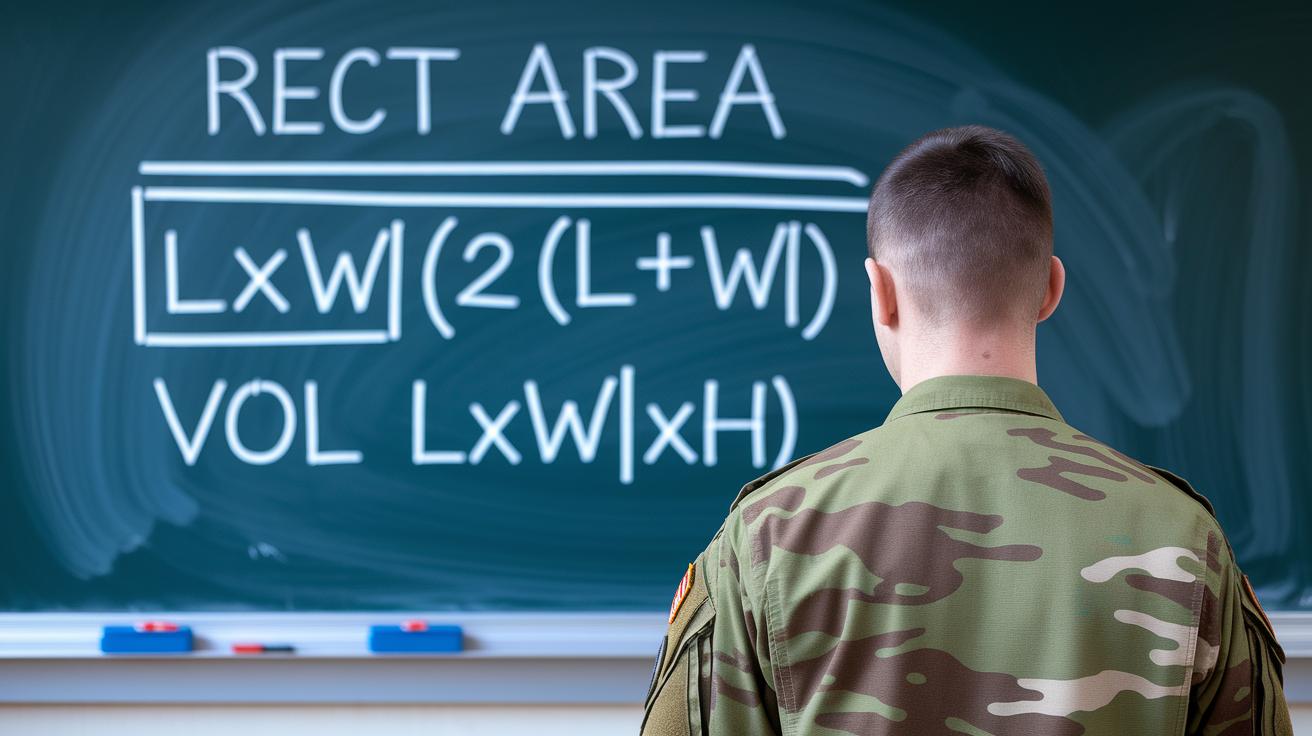
When you're getting ready for military math tests, having your geometry formulas down is like packing the right gear for a mission. Consider a simple rectangle. Its area comes from multiplying its length by its width, kind of like planning out a base camp where every measurement matters. And if you need to know the boundary, just use 2 times (Length + Width). It's like marking the perimeter for a practice formation.
Next, let’s talk about three-dimensional shapes. For a rectangular prism (think of a storage container), you get its volume by multiplying Length, Width, and Height. Picture checking how much equipment you can fit into a supply crate. The surface area, on the other hand, adds up all the sides with the formula 2 × (LW + LH + WH). It’s similar to calculating the exact amount of weatherproof coating for a durable container.
Each of these formulas is a useful tool for your calculations. For example, when you measure the cabin's edge, remembering to use 2 × (Length + Width) will help make sure everything's secure. In truth, mastering these geometry steps builds a strong foundation for your military math success.
Statistics Overview & Probability Theory Primer

Getting ready for military math tests means understanding data and chance. Start with the basics: descriptive statistics. This means you figure out the average (mean), pick the middle number (median), and identify the number that shows up most often (mode). For instance, with the numbers 3, 5, 7, 7, and 9, you add them up and divide by 5 to get 6.2 for the mean. The median and mode are both 7. These steps help you see where most of your numbers lie and how spread out they are.
Next, let’s talk about probability. Think about flipping a coin. There’s a 50% chance it’ll land heads. Now, imagine rolling two dice. The chance of both dice showing a six is 1 in 36 because you multiply the chance of a six on one die (1 in 6) by the same chance on the other. It’s a neat way to understand how chances work together.
Also, remember the Fundamental Counting Principle. This principle is like planning a mission. If you have 3 choices for one step and 4 for the next, you multiply them to get 12 possible outcomes. This little trick helps you quickly figure out all the ways a series of choices can turn out.
Wrap these ideas in your study routine, and you'll build a solid base for handling data on tests like the ASVAB. Keep at it, and you'll find that math concepts can feel just as clear and mission-ready as planning any operation.
Integrated Practice Test Simulation & Enlistment Arithmetical Drills

Set up your study sessions just like you’d approach a real test. This guide gives you up to 13 full-length practice tests with answer keys that explain every detail. Imagine sitting at a desk with a timer ticking away, each question is like a mini mission that builds your confidence and shows where you need extra practice.
Alongside these tests, you get helpful video lessons and fun math puzzles. They break tough topics into bite-sized parts so you’re not just memorizing steps but really understanding the concepts behind them. Step by step, you can track your progress and fine-tune your study routine.
Here’s a simple plan for a strong practice session:
- Copy the real test environment with a strict timer.
- Work through the full-length practice tests provided.
- Note and review every mistake right away.
- Go back to the manual to revisit tricky concepts.
- Watch your score improve with each simulation.
By making these drills a regular part of your routine, you’ll quickly find and fix your weak spots. If you’re after a structured guide, check out the simulation test strategies for military exam practice at https://militaryaptitudetests.com?p=1870. Each session is designed to boost your quick-thinking and reinforce your math skills, just like drilling tactics before a field exercise.
Revision Calendar Planning & Time Management Tactics

Making a revision schedule with dedicated daily blocks is a smart way to nail your military math exams. First, list your subjects from hardest to easiest and give each one its own time slot. This custom plan helps you mix practice tests with deep dives so you don’t feel swamped.
Try breaking your study time into sessions of 30 to 45 minutes that focus on one topic at a time, for example, fraction operations or rate-time calculations. This method keeps fatigue at bay and helps you remember tough concepts better. Plus, it’s a good idea to add in short self-checks to see your progress after each session.
Keep a simple tracker to log the topics you’ve covered and your practice test scores. Update your schedule regularly to mark your improvements. And don’t forget those much-needed breaks, a short walk or a few deep breaths can go a long way.
Follow these steps:
- List topics by priority.
- Set aside specific daily time slots.
- Plan short, focused study sessions.
- Track your progress consistently.
- Add in regular stress relief breaks.
A solid revision calendar helps you dodge burnout and keeps you mission-ready for exam day. Stick to your schedule and adjust it as needed to keep your study rhythm on point.
Resource Compilation Catalog & Supplemental Learning Tools

We've put together a military math study guide designed to make your exam prep feel as organized as planning a well-run mission. Inside, you'll find nine main sections, like a six-page guide on Arithmetic Reasoning and a five-page overview on Mathematics Knowledge, that break down tough topics into clear, step-by-step methods so you know exactly what to expect when test day rolls around.
But the guide doesn't stop with just the ASVAB. It also covers extra practice for tests like ACCUPLACER, AFOQT, GED, and GRE quantitative prep. In simple terms, it's a complete toolkit for all kinds of math exams, whether you’re focusing on military-specific challenges or broader academic ones.
You'll also enjoy interactive digital lessons that help break complex ideas into manageable parts. Imagine starting with fun, easy worksheets that grow more challenging, kind of like moving from a basic drill to a full mission. This lets you work at your own pace while watching your skills improve over time.
The guide offers even more support through online supplemental tools like a video tutorial series. These videos hit the pause button at key moments, for example, they explain how to figure out an 8% tax on $50 so you see it equals $4, making sure even the small details are crystal clear.
Plus, there are printable practice worksheets and engaging puzzles to keep you alert and focused during study sessions. It's all laid out to help you stay on track and feel confident every step of the way.
Final Words
In the action, we broke down core arithmetic, ratio challenges, and unit conversions, all with clear methods. We reviewed geometry, stats, and simulated drills designed to mirror real exam conditions. The guide also offered straightforward revision tips and time management tactics to keep study sessions effective. Every step is aimed at building solid skills, confidence, and readiness. Give the military math study guide a try and move forward with a focused mind and heart, armed for success on your exam and beyond.
FAQ
What does the free military math study guide PDF include?
The free military math study guide PDF includes detailed explanations, step-by-step arithmetic reasoning methods, and full-length practice tests tailored for ASVAB math sections to boost your exam readiness.
What math topics should I study for the ASVAB?
The ASVAB math study guide covers areas like arithmetic reasoning, mathematics knowledge, geometry, ratios, proportions, and basic statistics, providing the foundation to excel in the exam.
Is math on the ASVAB hard?
The ASVAB math section can be challenging yet manageable with proper prep. The guide simplifies complex topics with clear, step-by-step methods that help build solid calculation skills.
Is a 72 a good score on the ASVAB?
A 72 score on the ASVAB is competitive and reflects a strong grasp of math and verbal skills, positioning you well for quality military job placements and training opportunities.
What does the Mathematics Knowledge ASVAB study guide cover?
The Mathematics Knowledge study guide explains key concepts and problem-solving methods in algebra, geometry, and statistics, offering clear examples to help you prepare effectively.